Stepping out in the Tropics of Brazil

Brazil - The Making of a Novel - Part 17

The Journey - Recife  July 28 -- August 13, 1980
 
July 30: Not always possible to maintain an enthusiastic “high” - Once in a while, as now, it slips and you feel a real stranger.
 
Edson Nery, library “scientist” at the Fundação Joaquim Nabuco, a lay Benedictine monk, could not be nicer but has no concept of what it takes to write a book like Brazil. Yesterday was spent poring over museum collection - useful; today was passed in Foundation's library with excellent old engravings, also useful but dangerous:
 
I have to get out, experience and “look.” U.S.A. has best libraries in the world and when I'm back home I can sit in them for as long as is necessary. Here, I've got to see not pages but people. And the past insofar as one can separate present sights and scenes from what has been.
Recife, Pernambuco, Brazil
Edson is a dear librarian of special repute, no doubt, but too close to his books and eleven cats to see the finger-dirtying reality. A contemplative man, he himself says, grown pessimistic about the world and seeking his main solace in Sunday hours spent with the Abbot and Prior of the Monastery at Olinda.
 
So, though the day was spent in hard research and I got many visual images of use, I'm wary of over-involvement with the Fundação. Maybe they will come up with an engenho to visit and, of course, there's my interview with Gilberto Freyre himself. But I'm determined that these hours shall not be “book-bent.”
 
July 31: Once again proved that to accomplish things in the tropics you have to step beyond the lethargy so easily induced.
 
Day started with call to Edson Nery at home complaining very indirectly about lack of cooperation. Well, aside from suggestion that I go back to the library to look at more pictures this morning as planned, Edson showed clear understanding of my needs. A car will be arranged!
 
And it is: In afternoon my Recife travels begin in earnest. I'm also invited to dinner tomorrow night with anthropologist Dr. Robert Motta and friends
 
Afternoon visit to Iguaraçu, site of first church in Brazil, built 1535/plus Jesuit church/and third church atop hill. All vital to story since it is vicinity between here and Recife proper that I will place Cardosos (“Cardoso” family later changed to “Cavalcantis.”) Have to find way to move to second locale. Will probably be after Dutch invasion with re-start further away.
 
Convento de São Francisco - Olinda  Vladiney Pimento/Wikipeida
 
My guide, Amalia Correa, proves as fascinating as the historical aspect. Her brother was Minister of Agriculture under Goulart. Father was federal deputy from Pernambuco representing Bom Jardim to the north. Family is obviously one of the older political ones with classic coronel (Cardoso?)and wide connections.
 
Memorable anecdote of Amalia's sister who teaches at a favela in the evenings: "Simple things that people will understand like words for food etc. She explained 'meat.' Woman in class responded: 'Oh, I know meat but it is so long since I have tasted it.'"
 

"A Life of Constant Humiliation in Recife"

Brazil - The Making of a Novel - Part 16

The Journey - Recife  July 28 -- August 13, 1980
 
First impressions of Recife are grim and I suspect that they're not going to be altered as easily as Brasília. - Met my first Brasília detractor, Edson Nery de Fonseca. He lived there for twenty years, was Librarian of House of Representatives and calls Brasília “a crime against humanity.”
 
What I've seen of Recife seems to earn that appellation. Whereas we in “developed America” flinch at abandoned dogs and cats, here you have to get used to droves of abandoned children, abandoned people. I remember in Rhodesia (Zimbabwe) some years ago, remarking on the number of people, young especially, hanging around the streets of Bulawayo during work hours: Here was the real “security” risk.
 
Recife is a hundred times worse. Hundreds and hundreds of kids, adults, beggars with nothing to do; hundreds of others pathetically trying to make an honest living by selling anything from plastic toy planes to graters, packs of envelopes, sidewalk foodstuffs... Many gravitate to Recife from the backlands seeking a new life and, I suspect, invariably meet disappointment.
  
As Luiz “Black Jimy” said yesterday: “It is a life of constant humiliation.”
 
Alongside this cruel, brutal poverty is first real evidence of The Military. In Salvador, Brasília, in countless little villages, you see a few police/militia but here the presence is overwhelming. Traveling out to the Institute (Fundação Joaquim Nabuco) you pass base after base of one or another military establishment.
 
My immediate response is that this is a manifestation of government awareness of past rebelliousness on part of Recife/Pernambuco, traditionally a point of fire through every regime. Walk the streets and you can easily understand the “nervousness”...
 
As anyone who knows me will accept, I am not one to creep into a protective shell. I love exploring a new city by day/night, really “exploring” it and its people. Here, for first time, I feel a need for caution. Step out there, let things carry you along, and I sense real trouble. There are thousands in real need and desperate: One lone “American tourist” is a quick mark. (Like the licensed bandit of a taxi driver who charged me 400 cruzeiros for what should've been a 80cr. ride. Made up for it though, with bus ride x 18cr. = 200 taxi trip to Joaquim Nabuco Foundation.)
 
Difficult to believe that twenty-two days have elapsed since my arrival. Have covered thousands of miles, met dozens of people, many beyond the mere acquaintance phase. Toughest part of the trip is breaking fresh ground each time, going through the long introductory phase, establishing credentials. 

The whole day today was spent in this activity. But it's vitally important to opening up a city, situation for research. - Go slowly, let them understand you, above all believe in you, and so win their confidence. - I overheard Nery at lunch telling Fernando Freyre, Gilberto's son, “He is a serious student of Brazil.”
 
Got my first glimpse, at Museum of Man in the North-East, of artifacts of the sugar plantations: sadly impressive preponderance of equipment to keep slaves in their place. Worst was a device called "The World Turns” which would make a man into a ball-like figure binding leg and arms.
James S. Handler and Michael L. Tuite Jr.
(c) 2006 Virginia Foundation for the Humanities and University of Virginia
 
Edson Nery liked my description of Brasília as the ultimate "fazenda" and example of the coronel/latifundia way of life.
 
"Anna"(not real name,) a guide at Museum is from one of old families with an engenho (plantation) to the south. She expressed to this stranger all manner of statements about the poor summed up by: “It's the will of God.” The same is said by others in so many places...
 
Things like that make me realize just why all my traveling in the past is so important: To write a book for the world you have to know the world. You have to have a comparative base to work from, a benchmark against which you can “rub” your opinions and see how they come up.
 
Prosaic note: Lord, the food is monotonous: Steak ABCD/ Frango (chicken) ABC/Fish ABC/ That's it, day after day. For a week now I've had file (fillet)/contra file + beer + coffee!


Canudos: Visions of a Hill where God's Thunderer Roared

 
Brazil - The Making of a Novel - Part 15
 
The Journey:  Uauá and Canudos, July 25 — July 27, 1980
 
 
Arrive at Uauá to find contact arranged via Antonietta out of town for a week but within minutes his wife arranges for a family friend to take me to Canudos tomorrow.
 
Amusing introduction to Uauá in Hotel Gonçalves run by a mother and her five daughters. As word spreads, I find myself seated at table with twelve women of the town come to observe estrangeiro.
 
Hotel floor is divided into cubicle-like rooms with walls open at the top, the occupant of the room next to me snoring away happily all night.
 
July 25 - July 27. Two and a half days with no journal entry, through lack of time and place. Earlier efforts on bus inadequate/difficult and besides, observations in the sertão grow predictably similar. Which, in a way, is the point about the sertão: vast, repetitive, soulless backlands, mile upon mile of caatingas, close-packed, mind encroaching. Step into it a few meters from the side of the road and you are lost. It enfolds and absorbs you. 
 
                                           
A brief visit to Canudos on Sunday provided as much as I wanted from the "present." There's a danger of getting put off track by too much modernism. I have strong impressions and ideas about Canudos/Antônio Conselheiro and my mind relates them to the 19th century. — What I behold in the 20th is a distraction and can only water down those impressions developed from reading and thinking. Preconceptions, if you will.
 
Curious aspect of Sunday was “Manoel” from Mozambique and left after independence. Within minutes of meeting him, he begged me not to mention “Moz” because, hand on heart, “it was too much for him,” and “all because of Samora Machel.” Manoel sells jewelry in the Brazilian sertão after “Moz” and Rhodesia (Zimbabwe,) where he was a linotype operator.
 
I don't know how many Manoels there are in this country but cannot see them doing anything to improve race relations Brazilian style. Though first he wanted to avoid the subject, Manoel had more and more to say as the day progressed. Stories like the man who disowned his mother because she wrote from Portugal saying that he should come back to the motherland, but “bring nothing that you took from the blacks.” According to Manoel, the man wrote back to Senhora X saying from that time he did not consider her his mother. Manoel personally does not wish to tread the soil of Portugal because of the “traitors.”
 
Even as I traveled toward Canudos I had visions of this barren, wasted sertão where a mystic's most fervent ramblings could take easy root. Interpretations of Glauber Rocha aside, the site of Canudos today lies beneath a barrage! A placid backwater with a small island where a few goats and sheep are rowed across to graze.
 
Canudos Brazil barrage
 
Locals suggest that the flooding of the valley was a political move, but I'm skeptical. It was, so far as I know, commenced in 1953. At that time, the kind of political consciousness/reappraisal/revisionist tendency we have today was in its infancy. Few outsiders would have taken symbol of Canudos seriously.
 
Nothing, absolutely nothing, to suggest that 20,000 people died in this small valley, nothing to bring back the echo of the small cannon from a nearby hill or roar of "God's Thunderer" from the larger hill beyond....
Canudos refugees, 1897
Anyway, I got what I wanted, a soul-filling understanding of the terrain, of the small towns of the time, of the people. Was surprised by Mrs. Gonçalves (of hotel) reciting word for word a prayer said by an old man who'd survived Canudos. Though few beyond the area remember it, Canudos is very much part of local folklore...

On the Road in Brazil - "Lady Di" of São Raimundo Nonato!

Brazil - The Making of a Novel - Part 14
 
The Journey to São Raimundo Nonato July 22-24. 1980
 
July 22 The start of 2500-kilometer bus trip from Brasília to São Raimundo Nonato, Piauí and then to Uaúa near Canudos:
 
Within an hour of leaving Brasília, it begins to hit the senses, this “openness” with only the smallest dents of civilization on it. It's curious that with so much land, there should be a chronic possesseiros problem...
  
Road is hard-top with “breaks” of red dust. Bus takes them at 50/60 km/h. Overtaking on blind rises, corners, banging across rough stretches: amusement of some passengers, terror of others. Cars with lights on. Vegetation is deep, dusty red, every leaf, tree trunk. Dust curtain for a hundred yards on either side. Windows closed because of dust. Hot! Deviations (Desvio!) left and right. Telephone lines draped on tree branches. Vast ranches. Dust covered Brahmin-type cattle. Road workers waving. Passing vehicles hooting. Long red vein to horizon. Strikes me as one of areas of “last great adventure."Brazilian backlands Bahia
 
You don't know Brazil until you have sat with its people hour after hour, banging across dusty roads, nose blocked, throat parched, on and on through the day and night. Poverty stricken worker next to me. Says little. Half a tooth on upper jaw. Dust-stained white linen bag with possessions. Dress of same material.
 
July 23 7 a.m. “Asfalt!” Acclamation through bus after night on dirt. Road still primitive. Drifts, no bridges, taken at healthy speed. Remote “All Night” road stop. Ghastly meal. Outside, incongruous sight of attractive girl, a fazendeiro's daughter and his sons with brand-new tractor that won't start.
 
Old man in pink trousers and grandson sit next to me.
 
8.15 a.m. Start of true sertão. Green now but you can easily imagine it in a drought. Flat-topped table hills, eroded, red sand. Simple house of mud and palm thatch.
 
12.30 p.m. Looks as if trip to first point shorter than expected. A mere 24 hours! Delighted by prospect since glance at motorista in his rear view mirror shows him battling to stay awake. Madre Deus!  
São Raimundo Nonato - Photo: Blog do Francisco Evangelista
July 24 And now for something completely different. Arrived at São Raimundo Nonato at 5 p.m. yesterday. Palace Hotel room = something like old stable, no glass window, overlooking morass. Realize that I've been awake/traveling for 48 hours. Go to buy pen at shop. Owner refuses to take my money. Say thanks and go down street. Followed by car.
 
It's the guy who gave me the pen. Asks if I want to have a beer. Joined by João Raimundo, fourth year law student who speaks perfect English. Sit talking at outside table, watching people begin to gather outside Palace Hotel. Suddenly town lights fail and we sit in darkness. Lights come on and reveal crowd outside hotel entrance.
 
The reason: “Lady Di” has arrived from São Paulo coming to sing for the locals!
 
They wait eagerly and so do I until midnight when at last “Lady Di” appears at hotel entrance and walks grandly over to next-door disco for her performance.
 
The “disco” is open, unroofed, more like a basketball court with three hundred people jammed into a hundred-by-fifty foot space. Chaos.

"Lady Di" sings to the packed crowd. She could've been the real thing, so swept away were they. Her concert over, she is followed back to the hotel entrance by adoring fans. I also make my exit.
 
As I write up these notes, the live disco band is belting out a tune. God knows what time this will go on till. I fear "Lady Di" will make a second appearance at 2 a.m.
 
If these people can be so easily swayed by their great "Lady Di," how much more by an Antonio Conselheiro!
 
I pray the lights fail in the next ten minutes. (They don't.)

Brazil - The Epic of a Great Nation


A Giant Leap of Faith in Brasília

Brazil - The Making of a Novel - Part 13

The Journey: Brasília - July 18 - July 22, 1980

Curious that I should move from the start of my book to the end - from the shores where the Portuguese landed to the Brazil of tomorrow.
 
The impact is a sensual shock - from vibrant, dynamic, historical Salvador to this futuristic fantasia. Impressions rush at you. This is not Brazil? An attempt to outdo the U.S.A.? It doesn't represent natural outgrowth or mobility of traditional Brazilian society? Orwell's 1984? Kubrick's 2001? A giant leap of faith? Indication of a future Brazil, its spirit homogenized, sanitized?
 
 
Brasília Pilot Plan
First “experience” was seeking house of Ambassador Vladimir Murtinho. City is divided/sub-divided/sub-sub divided into quadrants, nothing so messy as telling, colorful street names. You live in Quad X, Block Y, House Z. Planned, no doubt, for easy reference. To my amusement,we are unable to find the house. It's in the Ambassador's Quadrant, No 6. House numbers go 9, 12, 6 ???   
 
Marie Eugenie who is driving me around tells of serious social problems of Brasília. High suicide rate, high divorce rate. She has been here three years (from London; husband a banker) and finds the city with the widest open spaces of any to be claustrophobic. Living in this isolated spot in mid-South America with thousands of “functionarios,” government officials. “Two and a half hours' driving to the nearest proper town,” she says!
 
A modern-day colonization scheme with first-generation immigrants from other parts of Brazil setting up here and having all problems of first generation in a foreign country. Though these arrivals from Rio etc. find it difficult, Marie Eugenie says their children love Brasília. In a generation or two it will have people knowing no other place, no other life style and they will give it spirit.
 
 
Yesterday, first work day in Brasília once again showed tremendous response to ELU and Brazil. Dr. Aloisio Magalhães (Secretary of Culture) provided a great reception via members of the Madeira-Mamoré project. After morning with them, Marie Eugenie (Magalhães's secretary) took me over to Ambassador Vladimir Murtinho at the foreign office.
 
Lunch with Ambassador Murtinho. — My “da Silva” family at their finest! - Magnificent home on shore of Brasília's artificial lake built to change excessively dry climate.
 
Murtinho has been involved with Brasília since its foundation. He is an ardent supporter of the concept and believes that it represented a turning point in Brazilian history. Provided nation with move/incentive/drive toward modernization of the country - from this massive symbolic act everything else has flowed. (Good point, but need to have his opinion on millions left behind by modernization.)
 
At a pool party two days later with two visiting artists and Vladimir's brother, Brazilian ambassador to Ecuador.
 
“Yes the people are poor, but it's because they're lazy. They don't care about improving themselves,” a guest comments.
 
Think I've mastered the way of working here: a 24-36 hour “introductory” process before acceptance “in.” My burgeoning list of contacts who genuinely want to help is such that I'll soon have too many to handle. They're amazed that anyone could attempt so vast a project. “No Brazilian would dare.” - They probably think I'm either a genius or a madman. A little of both? As has been case since arriving, my optimism continues to grow.


A Walk on the Beach with Pedro Alvares Cabral

Brazil - The Making of a Novel - Part 12

The Journey:  Porto Seguro/Salvador July 12 - July17, 1980

Thirteen hour overnight bus ride, Salvador to Porto Seguro.
 
Nothing on earth could make me believe this could be true: Here, in Porto Seguro, I meet Iva Lee Hartman ex West Virginia, ex-Bryanston/Three Vikings/Bryanston Country Club/Ciro's/my godfather's nightclub, Diamond Horseshoe (places Iva frequented in Johannesburg, South Africa.)

Iva now lives in Porto Seguro like a decadent aristocrat as owner of “Campo Gringo” resort and “Engenho do Duque.” From three to nine p.m. spent in company of this lovely/sad/lonely/exotic figure, as memorable a meeting as anything yet in Brazil!
 
I'm working on Porto Seguro contacts: Senhor Benedito, “town crier” promises meeting early hour tomorrow. As I write I realize that I've not slept since 8.00 a.m. Sunday 12th; now 10 p.m. Monday 13th = 38 hours. Good night!
 
The beach at Porto Seguro, Brasil
 
Curious thing about Porto Seguro is that though this is where Pedro Álvares Cabral landed, scene of the “discovery” of Brazil, there is little to mark so momentous an event for the people of Brazil.

There is a Cross, several in fact, at the alleged landing spot - stark, little adorned, no more. A decadent Indian village - Patachos - around the Cross, selling necklaces, feathered arrows, other trinkets.

Craig Hartman tells me some local townsfolk wanted village moved. I wonder whether they saw irony of the Cross and the ruined people at its feet.

The Cross as symbol of the advent of the Portuguese; the curio-selling favela as symbolic of what the Indians who welcomed Cabral inherited.
 
Errol Lincoln Uys at the Cross, Porto Seguro

Sixteen kilometers away from Porto Seguro to the south is Cabrália Santa Cruz, which claims to be site of first landing.
 
Who is correct? I'm told by Antonietta that accepted historical view is Cabrália, not Porto Seguro - which must irritate the hell out of its people, for it's truly depressed compared with Porto Seguro. Cabrália also seems far more noted for relics of an ill-fated French vessel which foundered on its reef. Its “restaurant” decorated with the ship's hawsers, ventilators, life belts etc.
 
A reflection on the days of Cabral... Porto Seguro
 
Can hardly imagine reaction of the Portuguese who got here first. The magnificent beaches, the groves of palm trees, the hills in the background leaning toward the shore, their heights offering special defensive positions.

Landing of Pedro Álvares Cabral, Oscar Pereira da Silva,
Museu Paulista , São Paulo
First Mass in Brazil, Victor Meirelles,Museu Nacional de Belas Artes


I'm increasingly impressed with outgoing friendship of the Brazilian people. Group at supper watched me eating alone and invited me over. Two couples from São Paulo, who afterwards asked if I would like to go for a walk. They share their spontaneous enthusiasm for Brazil, the future of their country - We talk of African/Indian folklore, its fundamental force behind Brazilian culture.
 
(Back in Salvador) After all my worry about visas etc., Antonietta says I'm fortunate having a South African background. Brazilians do care but know little of apartheid. Show that you do not support that insanity and they're likely to be far more receptive to you than they would be to a North American.

Antonietta is, of course, first major contact and there'll be other opinions, but she speaks of underlying resentment toward the U.S., its multinationals, its prejudice toward Brazil.
  
I've been here ten days and my sense of identification with the Brazilian people grows. They're vibrant, friendly, energetic - a nation imbued with the pioneer spirit. They have a vision that theirs is a nation going places, though the direction is not always clear.
 
The contrasts between rich and poor, old and new, were initially staggering to me and remain so. But even among the poor, there seems no utter wretchedness: even they have a sense of the potential of Brazil, and thus, hope.
 
I see this hope in a small self-help program at Porto Seguro and Cabrália: the townspeople have tackled the problem of the abandonados by giving the youngsters jobs as tourist guides. They're taught to lead visitors through the old parts of town. Twenty years down the road, I'll lay a bet, one of them could be running his own tour operation.

Brazil - The Epic Novel of a Great Nation and Its People

A Day at Modelo Mercado; A Night with "Decadent Aristocrats."

Brazil - The Making of a Novel - Part 11

The Journey: Salvador, Bahia  July 8 - July 11
 
Grab a few hours this a.m. for “office work.” Must allow more time for mental appraisal/assimilation of the barrage of information. Feel pretty secure with picture of Bahia for Tomás's arrival, Padre Inácio etc. (These are characters from my Outline for Brazil written earlier and based on book knowledge of Brazil and research in Portugal.)
 
Went to Antonietta's house in Sapateiros. Drunk, soiled beggar in doorway. We spent three hours poring over books from her four-thousand volume library. Especially impressed with her bandeirante material. Rest largely comprises works on churches, churches, churches. “Nossa Senhora” (Our Lady) are two words I'll never forget
 
In afternoon we go to the market, Mercado Modelo. An explosion of life Bahianese! Essentially a tourist/handicraft market, it has a restaurant attached to it. A vast meeting place where beer flows like water and people sing the songs of Bahia. For three hours, we eat and listen to the Afro-Brazilian rhythms. Again bringing a thought of the “release” from the slave quarters. (My South African heritage shames me in this blackest of all Bahiana cities!)
 
Historic Salvador, Bahia
with Mercado Modelo  Photo: Fernando Molina/Wikipedia

Back to Antonietta's house in the oldest quarter and for four-and-a-half hours she sits reading my synopsis. Her verdict is ENTHUSIASTIC! And a good deal more! Few Brazilians know the history as ELU, she says. Encouraging.
 
For an hour afterwards, we sit talking about the political realities, '64 to present. Troubling. She explains background of the opposition PF (Popular Front) to which she belonged aimed at grassroots change, alongside PCdoB(Communist Party, Maoist) and PCB (old Prestes group, pro-Soviet.) Also active were Focustas (from “focus”) who became most radical element. After congress, PF merged with PCdoB to work for reforms.
 
Pro Democracy Demonstration in Brazil 1984
Photo: Jorge Henrique Singh via Wikipeida

She talks of strong-arm methods/disappearance of friends etc. All very similar in most respects to South African situation.
 
Not clear of objectives, though main purpose “to improve condition” of the people. That's too broad for my liking. In recent times, things appear to have eased up but not clear to what extent. She stresses role of the Church. Even though it may not be evident in outward ways, e.g. church attendance, the Catholic spirit is fundamental to Brazilians.
 
Antonietta refers to 1 percent of population being truly “educated,” traveled etc. including those like herself whom she describes as “decadent aristocrats.”
 
Our talks end at 1.40 A.M. I've decided to move to Porto Seguro on Monday morning; Brasília next Thursday.

The Sound of the Bells and the Crack of the Whip in old Salvador

Brazil - The Making of a Novel - Part 10

The Journey: Salvador, Bahia  July 8 - July 11

July 8 I'm determined to keep this journal daily so though it's late, after a delightfully exhausting six hours with the best contact I've made in three months, I'll scribble a few lines.
 
Prayerful as I was last night, today started at 9 a.m. at Henriques' office. 9.10: “There is a problem.” - “Urgently called to accompany the director to a distant town to discuss plans for centenary etc.” - “Please come to Sally's office and we will find somebody.” Temper rising but nothing I can do about it!! Patience. Sally makes phone call to "Antonietta" at the Archives. She can meet me at the Cathedral at 4.30. (Today, all Bahia life grinds to a halt because of Brazil vs. Spain soccer game.)
 

Salvador Brazil Cathedral
Cathedral at Salvador, Bahia
Kill time noon to 4.30 including bumping into exuberant Germans who were in taxi with me Tuesday a.m. They've “seen it all” - three hour tour and night of folklore and are leaving for Rio at 2.30! At 4.30 find  Antonietta (de Aguiar Nunes) waiting in the doorway of the Cathedral. Go through my routine "introduction" again but this time find a perfect gem. A history professor mastering in social work, Antonietta “knows it all,” genuinely.
 
Plunge into a three conversation, then to dinner at Pelourinho Square (restored by UNESCO) at "hotel school" that offers forty kinds of Bahia cuisine = African modified by spices of East (as per fleets from India.) Tomorrow we're to meet at nine to continue the “researches.” The Good Lord be praised! Despite the Henry hitch, all augers well for the Brazilian adventure.
 
July 9 — A brilliant day! Won't attempt to repeat what's in my working notebooks. (Besides my journal, I filled a pile of notebooks as I went along.) Antonietta's contacts are stupendous, her enthusiasm unlimited. Now to bed, for I'm exhausted but in these early days of the journal, determined to make some entry, no matter how insignificant.
 
July 10-11 — Missed two nights' entries. Not through “sloth” but time! July 10 occupied with “re-creation” of 18th century Bahia. How the Portuguese must've loved this city! With its narrow, hilly cobbled streets, it is strong reminiscent of Lisbon and Coimbra. Most impressive is the Pelourinho - Pillory Square - with the old townhouses of the wealthy. The Pillory was moved here at the request of the Jesuits - it had previously been near the Cathedral - the lash and the bell/choir aren't compatible.
 
Salvador Brazil
Salvador, Bahia, Brasil
 
I am slowly conditioning myself to life as lived here. On Thursday evening Professor Antonietta and I are invited to plantation 70 kilometers north with loan of car. On Friday evening the invite falls through. "A's" sister has arrived. "A" needs car and so on. Change plans. I wander streets by myself.
 
Among many sights is a carpenter's shop. Men at lunch round table surrounded by wood shavings, playing dominoes etc. One-eyed carpenter. Easily 18th century!
 
In evening we go to sound and light show at 17/18th century seafront fazenda that includes tobacco warehouse/slave quarters. Can't follow libretto and am somewhat irritated by excessive use of colored lights but get the ambiance.
 
Nothing impresses so much as the voices of the prayerful from the small chapel rising alongside crack of a whip wielded against the slaves. Can see why the Jesuits asked that this scourge be moved from their holy place.
 
Earlier in the day visited convent with foundling wheel — larger than I expected — Some said it was an excuse for the nun's own progeny. Convent built by a wealthy man with five daughters. All the girls consigned to the building for life. Nice pater!

Landing in Salvador - Princess Paraguaçu, Two Abandonados, a Cockroach and a Prayer

Brazil - The Making of a Novel - Part 9
 
The Journey; Salvador, Bahia, July 7 - July 14
 
(Landed at 3.40 a.m.) Early morning arrivals are disastrous, especially when coupled with congress of six thousand medicos starting tomorrow. Good-intentioned cab driver drops me at sea front. Gray sky, showers, pre-dawn humidity. First hotel full, second $50 a night. Find myself walking back toward Centro after stop for Coke at kiosk where my “jacket Americano” is main interest. Also my $1 note for Coke. Scrawny woman creeping in and out of shadows to beg a cigaretta.
 
Finally made it via VW taxi to “Hotel Imperial” in Centro at 6.15 and get room at 900 cruzeiros (91cr. to $1.) A benign fleapit. Shocking pink walls. Cockroach at eye level when I wake five hours later. Noise. Deadly shower system (loose electric wires dangling from heating unit) but probably a lot better than what lies ahead and able to keep me within my $30-a-day budget. (And, as usual, contradicting LdJ's observations on “horribly expensive Brazil.”) I had perfectly adequate dinner of chicken, feijoas, rice, salad, beer and tip for 330cr. ($3.50)
 
Salvador Brazil harborFirst impressions of Salvador come from the large black population. Were this not Brazil, you could expect to awake in a West African seafront town.
 
First encounter with abandonados particularly memorable in visage of two little girls who'd steal many a U.S. heart. Sad if one considers all the implications beyond the empty soda tin thrust toward you but yet not pathetic.
 
There was a liveliness, a vivacity, as in their response when a customer at the snack bar ordered a glass of water which he tossed over them! In contrast, a young boy who was approached stopped to talk with the prettiest of the two girls, gave her a fond clasp on her shoulder - no money - before going on his way.
 
The urgency of getting down to serious work after the Portuguese experience impresses upon me. By 4.30 I've spent two and half hours with the Bahia information people who seem much more on the ball. Arrange to spend day with Henriques Caldeira. I'm impressed with the “sense of history” shown by these first contacts: Dona Linda Conde, who spoke of a plantation that's been in her family for 250 years; Henry who is Jewish and traces his ancestry back to the Dutch/Portuguese connection and Dona Gildene who is a great-great-great + granddaughter of Paraguaçu, the Indian princess who married Caramuru. Dona Gildene also has Dutch ancestry. (Must check influence of Dutch influence down here.)
 
This first brief foray suggests Bahia is font of Brazilian culture. Am also beginning to realize importance of maintaining this journal to remember all that comes at me and to have this “self-communication” each evening. This self-imposed silence for one so garrulous as me is unusual!
 
I go to bed quietly hopeful and prayerful. Have, as I did in Portugal with the likes of Serrão, prepared a list of “interests.” Pray God that they come up to expectations. I close Day One with a sense of cautious optimism.
 
Princess Paraguaçu and Caramuru


The Epic of Brazil on Amazon Kindle


“Through the lives of two powerful families, Brazil depicts five turbulent centuries in the history of a remarkable land. From colony to kingdom, from empire to nation, Brazil is filled with memorable people living through one of the great adventures in human history.”

A masterpiece! Brazil has the feel of an  enchanted virgin forest, a totally new and original world for the reader-explorer to discover.  L' Express, Paris

Pulsing with vigor, this is a vast novel to tell the story of a vast country. Uys recreates history almost entirely "at ground level," through the eyes and actions of an awesome cast of characters.  Publishers Weekly

Uys has accomplished what no Brazilian author from José de Alencar to Jorge Amado was able to do. He is the first outsider with the total honesty and sympathy to write our national epic in all its decisive episodes. Descriptions like those of the war with Paraguay are unsurpassed in our literature and evoke the great passages of War and Peace.  Wilson Martins, Jornal do Brasil

The Kindle edition comes with a free Illustrated Guide to the Novel.
 

Brazilian Adventure - A Call to Paradise or to Hell

Brazil - The Making of a Novel - Part 8
 
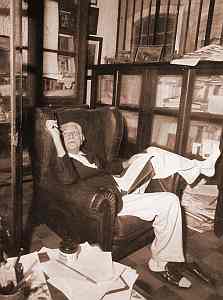
The famed Brazilian sociologist, Gilberto Freyre, asked me whether I based my story of generations of Cavalcantis on the secret unpublished journal of a Brazilian family. There were times during my five year odyssey on Brazil when I surely wished I possessed such a private diary. - There was no diary only the will to understand the Brazilian “thing.”
 
Professor Gilberto Freyre
Part of that understanding came from the journey I took over four months in 1981 traveling 20,000 kilometers through Brazil, almost entirely by bus. I visited the Casa Grandes; the big fazendas; the splendid beachfront apartments; the glass and concrete wonder of Brasília - the new El Dorado! I walked the sands of Porto Seguro; I rejoiced in the atmosphere of the Bahia; I stood in silence between sepulchral hills at Canudos. I climbed another hill, too, to gaze down on Vila Rica do Ouro Preto and imagine the handicapped sculptor Aleijadinho moving along Vila Rica's cobbled streets. I heard the muffled drum of tyranny presaging the last act in the drama of Tiradentes, martyr of Brazilian independence.
 
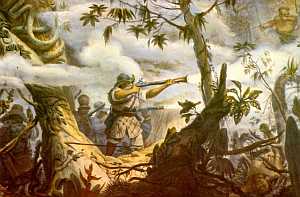
I wandered the sertão, the backlands, not just the wilderness beyond Bahia and in Amazonas but the sertão of the favelas of Recife and Rio de Janeiro. A literary bandeirante penetrating Brazil's past like those seventeenth century pathfinders, often feeling the thorny caatingas closing in on me but compelled to march forward like my hero, Amador Flores da Silva:
                               
To Amador, to his father, to all who traveled with them, there would be no expression more evocative, more meaningful than sertão. 'Backlands;' 'wild country;' 'the unknown forest;' 'hill, valley, river hidden by the mist of Creation;' 'place of thorn and desert;''brutal land without end' - sertão was all these and more. It started not beyond the next rise or across the river ahead but deep within the soul, a call to paradise or to hell...

The Bandeirante - Debret
 I kept a two hundred page journal on my four-month expedition across the length and breadth of Brazil. The scrawl on some pages vividly brings to mind a motorista, a bus driver, hanging on to the wheel as we sped through the caatingas. I remember triumphant cries of Asfalt! as we careened off a dirt road onto the hard-top. I remember glancing at a rear-view mirror and seeing a driver nodding off with half-closed eyes. I remember a girl in the seat next to me on her way to join a nunnery saying a prayer...               
 
Some glimpses follow from a journey that lies at the heart of Brazil. I'd begun my research travels in Portugal where I stayed for three months in Sintra, the 'glorious Eden' of Lord Byron. I tried teaching myself Portuguese and learned enough to decipher the written word, more or less, but spoke the language poorly. I wrote to half a dozen people in Brazil in advance but essentially landed at Bahia, Salvador without a single contact... Journeying through Brazil in 1981, I traveled through the heart of a nation in which the flame of freedom was newly lit after years of military dictatorship, my journal colored by the voices and emotions of the era.