Showing posts with label Manaus. Show all posts

The Burning Forest: Eyes on the Invasion of the Amazon

Brazil - The Making of a Novel - Part 31
 
Porto Velho, Rondônia, August 24 — September 1
 
Traveling from Manaus to Porto Velho again underlined the poor attempt at “conquering” the forest — the pathetic little farms alongside the road, the road itself tarred but in a state of disrepair. Almost like traveling on a dirt road, the bus swerving from one side to the other to avoid potholes and sections of the road that have completely degraded.
 
Atmosphere is pioneer, perhaps no better typified as in roadside “restaurants” - crude, wooden affairs catering to buses and truckers, serving one or two dishes only, great piles of food, rice, spaghetti, farina, chicken or beef, and stocked with only bare essentials.
 
Amazon Forest Burning Brazil Uys
 
Found sight of smoldering embers of destroyed forest beside road disturbing; nothing seen thus far has convinced me settlers know what they're doing.
 
As one informant said: they clear thousands of hectares adjoining the forest for cacão plantation and introduce cacão trees. What they ignore is forest's own defense mechanism:
 
Will it introduce new species of insect or disease to fight this invasion of its territory?
 
I like this concept of forest as a separate, living entity existing by and for itself, something surrealistic, but need to see it as such to reflect on its relationship with man.
 
Amazon Forest Burning Brazil Uys
 
In a small town like Porto Velho, you cannot help noticing excessive number of government organizations. In the downtown area virtually every street has its EMBRATEL, INCRA, INDECO, SUDENE etc - endless offices of functionaries all aiming at one or another type of disinvolvemente. (A strange word to my ears, for translated it means development; having seen some of these functionaries in action you wonder just how much "disinvolvement" gets done.)
 
At last, the Madeira-Mamoré railroad. Strange feeling of unreality today accentuated by sight of swimming pool, good food (!)and out in Porto Velho's blazing hot rail yard: abandoned engines and rail construction equipment, birds nesting in a great steam powered crane that once moved along the newly-laid rails.
 
As in Recife, Belém, Manaus, much of the historical atmosphere has been destroyed. It takes a special effort of imagination to recapture what it must've been like - to envisage it in the days of Vicente Cardoso (Cavalcanti.) Feel especially confident of Vicente as character and almost capable of writing about him now.
 

A Meditation on the Great Cathedral of the Amazon Rain Forest

Brazil - The Making of a Novel - Part 28
  
The Journey -  Amazon River,  August 23, 1980

 
August 23 Maybe it was the heat, maybe the “intrusion of tourist types” but the five days spent at Manaus seem the least productive, including entire day wasted waiting for director of INPA, Amazon research institute, from 10.30 till 4. Spent the time in their library. When she eventually saw me, she told me to return the next morning at 9.30. I did and was told a) no one available for an interview b) no one to go with me to the “forest.”
 
At which point I said to hell with it and sought out my own boat on the waterfront Manaus Small Boat Dock Brazil Uysand found a personable navigator — Daniel! Six hour trip to confluence of Amazon and Negro, then into Solimões and through narrow creeks to enter cathedral-like forest. Exactly what I wanted.
 
Arranged a second trip for yesterday, another six hours, this time north, very different as we went through forest to cachoeira where we swam. God knows what you could pick up!
 
Perhaps it's the influence of the other estrangeiros who come filled with visions of tropical menace and talk of all manner of ailments but I find myself becoming “health conscious.” Won't dare miss my malaria tablet; bathe open “wound” on my foot a) with antiseptic solution b)powder antiseptic c) cover with Band-aid. Ultra careful with water and absolutely refuse salads.
 
Words like malaria, yellow fever, typhoid, hepatitis, septic wounds etc. commonplace in vocabulary but perhaps it's something else that calls for caution. In the U.S., in developed countries we have reached an ascendancy of man over Nature, control lies in our hands. The environment has been conquered and controlled physically and spiritually. Here, not so: when you enter the forest environment you are entirely at its mercy. Man is out of scale here, his size nothing against the horizonless, surrounding forest.
 
Again and again, I think of the entradas: How the small band of Raposo Tavares could have found its way through the jungle is amazing. Deviate for one moment from the mainstream and you enter a maze of water that twists through the forest, sometimes spreading like a lake, sometimes splitting into different streams that take off in several directions.
 
For an hour on Friday we drifted down a section of the Solimões, engine shut
 
Amazon River Bank Brazil Uys


off, everyone silenced. It was like meditation in a great cathedral. The trees offering every shade of green, the waters of the river colored green with their reflections.
 
A forbidding environment, gnarled roots of trees exposed on the banks where storm waters have torn away the soil; trees standing in the water, dead twisted shapes awaiting the final thrust of nature, when they will loosen their hold on the soil, fall and be carried away. Clumps of hyacinth stretch out from the banks, sometimes grow like small islands midstream.
 
Inside the forest, the water is smooth as glass, the area deserted, only occasional glimpse of a canoe with a fisherman sitting cross-legged up front, bow and arrow ready for action. A scene that was the same hundreds, thousands of years ago.
 
Waters deep blue out in the great rivers Amazon and Negro, a turbulent brown and blue at confluence, green in the forest. Brown, too, with soils carried down from the Andes.
 

In the Heat of Manaus - Walking with the Ghosts of the Opera House

 
Brazil - The Making of a Novel - Part 27
  
The Journey -  Manaus,  August 20 -August 23, 1980

 
August 20 Docked at Manaus on 17th, 18th interview preparations, 19th visit EMBRAPA, 20th to INPA, Amazonia Research Station. First word to describe Manaus is HOT. Heat that brings tiredness, lethargy and seems to slow down pace of everyone.

Like many Brazilian (and South African) cities tendency has been to knock down the old in boom/bust growth. Interspersed are buildings from rubber boom days, highly ornate structures totally out of context with local atmosphere. European-style buildings transported to the Manaus Old and Newmidst of the Amazon jungle. Somewhat typical of many Brazilian cities, this failure to incorporate the local climate and scene into architecture. At least, Manaus is cleaner, less repressive/oppressive than Recife.
 
First three days sharing hotel room with Englishmen Rod and Mark, fine company, fine hotel, OK at 3200 cruzeiros for three but after they left I moved this morning to god-awful place only 800cr. less. No hot water, five beds in room. Carpetless floor. Practically windowless. Depressing! Reconcile myself as I look at pictureless, grimy walls that I am saving 800cr. a day = meals.
 
Don't have any real contacts here, so it's a long slog to get something achieved. The usual day spent in presentation and selling of oneself. Saw most of group from boat but realize that I have to distance myself from them, even though the conversation was wonderful.
 
I'm anxious to move on to Porto Velho but feel that I have to stick it out here until I've had a proper introduction to the Amazon forest. So far what contact there has been lacks intimacy, the feel of the place, but perhaps the excessive contact with “foreigners” adds to the problem Will persevere!
 
August 20(PM) Manaus is like an island, the darkness out there, this hot night — the unknown, great swards of green as mysterious as the depth of the ocean. The isolation one feels is accentuated.

I see Vicente here (“Vicente Cavalcanti,” a character imagined for Brazil), a tall, robust, bearded and gaunt figure tramping these streets in 1910/1912,feeling a totally alien atmosphere, wanting only to retreat to that “green” ocean, to lose himself in that reality. I see him walking, lonely and frightened, through the Eiffel-designed marketplace with its iron work to the Manaus Opera House and Palace of Justice, past the gaudy little hotels trying desperately to offer some hold to Europe and a civilization far removed.
 
Manaus Market Panorama Brazil Uys
 
Don't know how the mind of a Brazilian works but can hardly imagine how a Rio/São Paulo/Brasília person relates this area to “his Brasil,” other than in a possessive-territorial sense, the idea of having this superb national treasure. Posed a question to Mark and Rod as we parted: “Who are the Brazilians?” A mighty one to answer but I know what I'm racing toward.
 
After thirty days in North-East, feel victim of North-East depression. Somehow, I need to experience something that will show the Hope, the Excitement of Brazil.
 
For thirty days I have tramped, bused and otherwise moved through the North-East growing increasingly downcast at life in the region. Even the Amazon is drawn in with the sight of downed, destroyed woodland and pathetic attempt to “farm” it — a vision aggravated by fact that farms visited belong to EMBRAPA researchers. God knows how hope-filled people from the North-East face staggering challenge to “produce” something, a livelihood, on such lands. Nothing said or shown by researchers convinced me that they're anywhere near solving the countless challenges.
 
In my more “mature” attitude to Brazil, keep reminding myself that though Michener wrote about South Africa, he detested apartheid. There are similarities in my approach/attitude toward Brazil. I find the history, the past, utterly fascinating; the present reflected, too often, in the filthy gray pools at my feet.

BRAZIL - The Epic of a Great Nation
 

Amazon Glory: The Dance of Sun and Moon on the Equator

Brazil - The Making of a Novel - Part 25
  

The Journey -  Amazon River,  Augusto Montenegro, Belém to Manaus, August 12 - August 17, 1980

August 15-16 Approaching, docking at and passage from Alenquer beyond Santarém late afternoon and evening gave dramatic impression of The Amazon.

The river divided into five channels with ship sailing in one furthest east and, far as the eye could see, these expanses of water separated by low strips of lands, occasionally merging, most continuing their separate way toward some distant meeting point. An hour time change — advance — at Santarém brought sunset early, a magnificent ball of orange, larger than any I have ever seen, going down with surprising rapidity, dancing behind the bank of trees as the ship moved along, sometimes obscured, sometimes appearing full circle in a gap between the forest. At water's edge, herds of zebu-type cattle standing white to gray against the darkening background. Channel narrower than ever.
Zebu cattle at fazenda on banks of Amazon River

Then, within minutes of the sun setting, the moon rising in the east, a smaller, perfect yellowish ball, also climbing swiftly and perfectly marked against the clear sky. Then night and the Amazon closing in — not the towering impression offered in Hollywood interpretation of small riverboat cutting through impenetrable forest but surrounding our ship with its vastness and the knowledge that way out there, only an endless expanse of uninhabited forest.
A scene my characters,Amador da Silva and Segge Proot would come to re-live in the pages of Brazil: 
 
"The constant green and gray and blue was also relieved — especially for Segge — by the dance of sun and moon on the equator. Daybreak and a faint blush in the gray would presage the rim of orange sun behind the trees. The surface of the river would be painted in way no mortal artist would emulate, passing through a spectrum of shades, from soft pinks and mauves to a fiery blaze that turned the waters of the Rio das Amazonas into molten gold.

These changes came with amazing rapidity as the sun climbed above the forest, its intensity giving a man from Europe the impression of high noon, when it was not yet midmorning. At sunset the flaming ball would sink, sometimes seen hovering full circle at the very edge of earth, where there was a gap in the foliage.
After the briefest pause, a small, yellowish moon would rise above the horizon and climb swiftly, the constellations growing pale, the higher it rose. Night would fall, the limitlessness heightened and made ominous by the close, impenetrable world of trees.


At night, we reached Alenquer, a small river port, its dockside crowded with people, sacks of grain... Sounds of countless insects in the marshy land beside the wooden quay. Go ashore for walk through town streets lined with bars. What truly sets the atmosphere is glimpse back toward the ship. Sight of her lying there lit for stem to stern, immaculately white and dwarfing every other boat at dockside. Here, unmistakably, is the picture of the Amazon I have always held.

At Alenquer, I sense a “resentful” reaction to our presence. People on the quay side, mostly young, remind one of scene from Amarcord. It's only twice a month that a large passenger boat comes through and being Saturday night, locals see this as one, if not the only “event.” But they didn't observe us with friendliness, very few smiles, and except two who made “friends” with blonde Elsa, the German girl aboard, not a single wave as the ship pulled away from the dock. Instead some First Class passengers started to throw ice at them and they retaliated with curses and handfuls of grain! Type of incident that does nothing to improve relations between the haves and have-nots.

Aboard, there is absolutely nothing to do but brood, meditate, sweat, drink and talk. Ron and Mark, two Aberdeen University graduates, future grain merchants, provide some worthwhile asides on Brazil. Ron maintains that the Brazilian “miracle,” the dramatic economic development since mid-50s had disastrous effects because it came too quickly for people to adjust to it, socially. “They entered the industrial age without capacity to cope with modernization, jarred from a post-colonial and agricultural phase into era of technology. Adopting the methods of an advanced country to one in which the mass of people still existed in backward phase.”
I agree with what he says and have serious doubts about the theory of Brazil as an emergent super-power. The first forty days contact with the people, admittedly of the depressed North-East, offer little hope for what may be a future “super-power.” Again and again, Bradford Burns's suggestion of so little having changed in five centuries as being key to Brazil appears perfectly true.

In Search of the Green Fortress: Four Ways to Look at the Amazon


Brazil - The Making of a Novel - Part 25
  
The Journey -  Amazon River,  Augusto Montenegro, Belém to Manaus, August 12 - August 17, 1980
 
There's a monotony to the trip, the same riverine line of forest, mile after mile, varied occasionally by a lonely house or small settlement, rarely what could be considered a town. Between leaving Belém and 12.30 today first major town (population 21,000) was Almeirim.
 
Keep trying to think of what journey must have meant to Raposo Tavares. Even today with only a five-day passage, people complain of boredom after two days. What must it have been like for Raposo Tavares? Week after week, as they passed along Madeira River to Manaus, and to Belém.


Very noticeable to me is complete absence of wild animals at the river's edge, so totally unlike even the smallest river in the wilds of Africa. Here, nothing!
 
Still find it difficult to come up with definition of "what" the Amazon is — Perhaps better to brood over it for a couple of days. — So many approaches:
 
1) A hypothetical one, for example: What if the riverine line of forest had only been a narrow one? And the lands beyond open to colonization? Would this not have been the focus of “civilization” in the Americas? Would the Andean cultures have spread into these areas?
 
2) Perhaps, in a way, the repetitive and boring aspect of this trip is for the very reason I state in my book proposal: The failure to see the whole, to comprehend how infinitely small this ship and its occupants in relation to the River; the failure to appreciate the symbiosis of river and nature.
 
3) Can see some likely effects the River can have on Brazilian outlook, for example, in reinforcing the knowledge of just how little impression they as a people have made against the vast lands they hold.
 
4) Serves to reinforce the Contrast, here the limitless land, and in so many other places, the struggle for ownership of the smallest patch of territory. Here is a “land problem” of a very different sort.
 
Amazon River Bank Brazil Uys
 
 
Green. Every shade of green possible, the patches of hyacinth floating downstream, the great trees to the water's edge, the canopy of the forest lower than one would've imagined it to be, low and dense, the sameness and yet a difference even to the untrained eye.
          
Have really to remember just how vast this is to understand what it must've been like for the early discoverers. Almost like being trapped in a tunnel, a water maze. Once you started out upon it, you had to complete the full journey. Penetration of the forest itself as an outlet would be impossible; follow any tributary and you would be led down another blind alley. Once you began you'd be locked into the main river until it reached the Atlantic.
 
Most memorable of shipboard characters: An old English couple who have lived in Brazil for forty-five years, Alan and Brenda. He was in insurance, came here in the 1930s after Fawcett's disappearance. In the 1940s he flew to Manaus; now retired, he is doing the trip again. Sitting in lounge, Somerset Maugham characters, playing cards after siesta. Brenda's memorable quote the other night was that after all these years she had not become i.e. gone "Brazilian" and went “home” last year. (Returned via South Africa about which they hold typical conservative views.)
 
Other travelers include noticeably older generation of Europe-style backpackers. They're a decade away from their first trip to Europe, moving into their 30s, too independent to come to terms with the "responsibilities of growing up.”
 
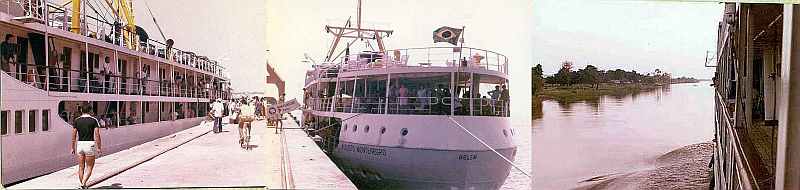
SS Augiusto Negro Amzon Brazil Uys
 

Amazon - I begin a Journey on the River Sea from Belém to Manaus


Brazil - The Making of a Novel - Part 24
 
The Journey -  Amazon River,  Augusto Montenegro, Belém to Manaus, August 12 - August 17, 1980

Amazon Map

August 12  Bus trip ended at 5.15. a.m. when I checked into “Litoral Palace Hotel” next to Rodoviária. On trip, noticeable how the true sertão gradually disappears. As you approach Teresina, capital of Piaui, the caatingas give way first to similar vegetation mixed with small palms, then a more benign landscape and beyond Caxais true African style veld. Green in spite of winter and with denseness that is suggestive of the great Amazon belt that lies close to the north.
 
I was thinking as we passed through one of the innumerable dusty/poor/
ugly/depressed towns of Piauí­/Maranhão that this must be a world away from what the rich of Rio/São Paulo know. I doubt whether one in a hundred have ever been here or seen any of this beyond TV. And if that is the case, how much more aggravated was the difference in the past, without “easy” communication of today?
 
Windowless room in "Litoral Palace" with giant fan, the size of an old plane prop. Woke at 12 and went to city to learn that the only boat to Manaus departs this p.m. Next one is on September 4 (perhaps.) Decide to Go.
 
Amazon Ship Augusto Montenegro Brazil Uys
 
August 13  Aboard Augusto Montenegro, up at 5.30 a.m. to witness spectacular sunrise, faint to deep orange sun rising over line of trees, climbing quickly into sky and by 9.30 making it as hot as midday. Size of River (Para) on approach to Amazon is truly “river sea.” Difficult to imagine impact on early voyagers like Orellano/Raposo Tavares reaching Belém from upstream.
 
Isolated settlements on river banks, buildings hugging shore line, church, bordered by trees.
 
Most sobering thought is that their only access to “civilization” is along the river. Hemmed in by forest, somewhat like an island; dozens of island “refugia” between forest and river. At point we're approaching now, water to furthest horizon, brown tinge to it.
 
Many estrangeiros aboard, international mix, Brazilian, French, Canadian, Israeli, American, English, German, students, retirees, holiday-makers, most with idea of once in a lifetime Amazon voyage. Agree. We're all traveling second-class; there's a First Class deck above and a deck “squatter” passage below and aft.
          
August 14 Why the Amazon has been called a “river sea” is easily imaginable. The extent of the river is such that glancing to one side, say starboard, you fully expect to be coasting along “offshore,” and if you turned round to port, there'd be the ocean! Everyone encountering the Amazon for the first time finds it larger than they expected. Difficult accepting that for five days you will be aboard a major-sized ship moving along the greatest (by water volume) river in the world. You have a problem seeing that very distant line of trees as the edge of the river and not a vast lake or the sea.

BRAZIL - The Epic of a Great Nation