Showing posts with label Brasilia. Show all posts

A Giant Leap of Faith in Brasília

Brazil - The Making of a Novel - Part 13

The Journey: Brasília - July 18 - July 22, 1980

Curious that I should move from the start of my book to the end - from the shores where the Portuguese landed to the Brazil of tomorrow.
 
The impact is a sensual shock - from vibrant, dynamic, historical Salvador to this futuristic fantasia. Impressions rush at you. This is not Brazil? An attempt to outdo the U.S.A.? It doesn't represent natural outgrowth or mobility of traditional Brazilian society? Orwell's 1984? Kubrick's 2001? A giant leap of faith? Indication of a future Brazil, its spirit homogenized, sanitized?
 
 
Brasília Pilot Plan
First “experience” was seeking house of Ambassador Vladimir Murtinho. City is divided/sub-divided/sub-sub divided into quadrants, nothing so messy as telling, colorful street names. You live in Quad X, Block Y, House Z. Planned, no doubt, for easy reference. To my amusement,we are unable to find the house. It's in the Ambassador's Quadrant, No 6. House numbers go 9, 12, 6 ???   
 
Marie Eugenie who is driving me around tells of serious social problems of Brasília. High suicide rate, high divorce rate. She has been here three years (from London; husband a banker) and finds the city with the widest open spaces of any to be claustrophobic. Living in this isolated spot in mid-South America with thousands of “functionarios,” government officials. “Two and a half hours' driving to the nearest proper town,” she says!
 
A modern-day colonization scheme with first-generation immigrants from other parts of Brazil setting up here and having all problems of first generation in a foreign country. Though these arrivals from Rio etc. find it difficult, Marie Eugenie says their children love Brasília. In a generation or two it will have people knowing no other place, no other life style and they will give it spirit.
 
 
Yesterday, first work day in Brasília once again showed tremendous response to ELU and Brazil. Dr. Aloisio Magalhães (Secretary of Culture) provided a great reception via members of the Madeira-Mamoré project. After morning with them, Marie Eugenie (Magalhães's secretary) took me over to Ambassador Vladimir Murtinho at the foreign office.
 
Lunch with Ambassador Murtinho. — My “da Silva” family at their finest! - Magnificent home on shore of Brasília's artificial lake built to change excessively dry climate.
 
Murtinho has been involved with Brasília since its foundation. He is an ardent supporter of the concept and believes that it represented a turning point in Brazilian history. Provided nation with move/incentive/drive toward modernization of the country - from this massive symbolic act everything else has flowed. (Good point, but need to have his opinion on millions left behind by modernization.)
 
At a pool party two days later with two visiting artists and Vladimir's brother, Brazilian ambassador to Ecuador.
 
“Yes the people are poor, but it's because they're lazy. They don't care about improving themselves,” a guest comments.
 
Think I've mastered the way of working here: a 24-36 hour “introductory” process before acceptance “in.” My burgeoning list of contacts who genuinely want to help is such that I'll soon have too many to handle. They're amazed that anyone could attempt so vast a project. “No Brazilian would dare.” - They probably think I'm either a genius or a madman. A little of both? As has been case since arriving, my optimism continues to grow.


The Woman with One Orange in Brasília

Brazil - The Making of a Novel - Part 7

More than the land, the Brazilian people themselves gave me the thousand and one insights I needed. Try to imagine a stranger coming to you and telling you he is going to write a novel about the entire history of Brazil. Five hundred years! A crackpot! Louco!
 
Bemused some were but with one solitary exception, a fiery young man of Manaus who flew into a rage and said an estrangeiro had no right to "steal Brazil's past,” save for this lone objector, I'd unstinting help and support from hundreds of people, some giving me days of their time, some only precious moments. An unnamed peasant woman standing next to me in a bus queue in Brasília and asking that I buy an orange for her sick child: I realized later that the orange was all the pair had for nourishment on a twenty-six hour bus trip.
 
I kept my daily journal during my trip and filled twenty notebooks. I pored over dozens of maps, paintings, photographs, absorbing and interpreting this mass of information as I went along. I was not bound by the same constraints as the historian, my book is a work of the imagination, but I was under an obligation to get the facts right. Foremost was an overriding desire to write a book that was accurate, balanced and avoided stereotypical images and over-simplifications that often mar the works of outsiders attempting popular fiction about Latin America.
 
Where my interpretations revise commonly-held views, I arrived at my conclusions only after the most critical thought.
 
My view of Brazilian slavery, for example, particularly the early centuries is harsher than what was usually portrayed.
 
I did not study Brazilian slavery in isolation but looked at the Portuguese record in Mozambique and Angola, particularly the degradation of the Congo; the more I thought about it, the less I believed that the harsh Portuguese slaver in Africa could miraculously be transformed into a paragon in Santa Cruz. Palmares was the quilombo that made "headlines,” but how many others were there? Tens of thousands of runaway slaves do not suggest a benign regime of bondage.
 
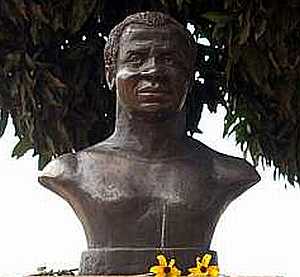
"Ganga Zumba" of Palmares
             
I asked myself time and again, and not only with slavery: through whose eyes was the past beheld? Almost never in a colonial situation does one find anything but the official story neatly penned for bureaucrats thousands of miles away.
 
I'm no “frock coat” devoted to the literary salon. I do not write staring above the heads of the mass of people. I like to get my hands dirty “to recreate history,” as one reviewer of Brasil said, “almost entirely at ground level.”
 
While generations of fictitious Cavalcantis and Silvas populate my landscape, I took great pains to bring to center stage a host of characters drawn from the masses. Affonso Ribeiro and his wild clan; Nhungaza of Palmares and his grandson, Black Peter; Antonio Paciência, the mulatto, slave, voluntário in the Paraguayan War, so-called "fanatic" at Canudos, above all, “Antonio Paciencia-Brasileiro!” A few of the many as dear and vital to me as the great men of the earth in Brazil, past and present.
 
In the end, one writer's search for the soul of Brazil -- an honest and sincere attempt to understand "the Brazilian thing."