Showing posts with label Brazil 2014. Show all posts

The Sound of the Bells and the Crack of the Whip in old Salvador

Brazil - The Making of a Novel - Part 10

The Journey: Salvador, Bahia  July 8 - July 11

July 8 I'm determined to keep this journal daily so though it's late, after a delightfully exhausting six hours with the best contact I've made in three months, I'll scribble a few lines.
 
Prayerful as I was last night, today started at 9 a.m. at Henriques' office. 9.10: “There is a problem.” - “Urgently called to accompany the director to a distant town to discuss plans for centenary etc.” - “Please come to Sally's office and we will find somebody.” Temper rising but nothing I can do about it!! Patience. Sally makes phone call to "Antonietta" at the Archives. She can meet me at the Cathedral at 4.30. (Today, all Bahia life grinds to a halt because of Brazil vs. Spain soccer game.)
 

Salvador Brazil Cathedral
Cathedral at Salvador, Bahia
Kill time noon to 4.30 including bumping into exuberant Germans who were in taxi with me Tuesday a.m. They've “seen it all” - three hour tour and night of folklore and are leaving for Rio at 2.30! At 4.30 find  Antonietta (de Aguiar Nunes) waiting in the doorway of the Cathedral. Go through my routine "introduction" again but this time find a perfect gem. A history professor mastering in social work, Antonietta “knows it all,” genuinely.
 
Plunge into a three conversation, then to dinner at Pelourinho Square (restored by UNESCO) at "hotel school" that offers forty kinds of Bahia cuisine = African modified by spices of East (as per fleets from India.) Tomorrow we're to meet at nine to continue the “researches.” The Good Lord be praised! Despite the Henry hitch, all augers well for the Brazilian adventure.
 
July 9 — A brilliant day! Won't attempt to repeat what's in my working notebooks. (Besides my journal, I filled a pile of notebooks as I went along.) Antonietta's contacts are stupendous, her enthusiasm unlimited. Now to bed, for I'm exhausted but in these early days of the journal, determined to make some entry, no matter how insignificant.
 
July 10-11 — Missed two nights' entries. Not through “sloth” but time! July 10 occupied with “re-creation” of 18th century Bahia. How the Portuguese must've loved this city! With its narrow, hilly cobbled streets, it is strong reminiscent of Lisbon and Coimbra. Most impressive is the Pelourinho - Pillory Square - with the old townhouses of the wealthy. The Pillory was moved here at the request of the Jesuits - it had previously been near the Cathedral - the lash and the bell/choir aren't compatible.
 
Salvador Brazil
Salvador, Bahia, Brasil
 
I am slowly conditioning myself to life as lived here. On Thursday evening Professor Antonietta and I are invited to plantation 70 kilometers north with loan of car. On Friday evening the invite falls through. "A's" sister has arrived. "A" needs car and so on. Change plans. I wander streets by myself.
 
Among many sights is a carpenter's shop. Men at lunch round table surrounded by wood shavings, playing dominoes etc. One-eyed carpenter. Easily 18th century!
 
In evening we go to sound and light show at 17/18th century seafront fazenda that includes tobacco warehouse/slave quarters. Can't follow libretto and am somewhat irritated by excessive use of colored lights but get the ambiance.
 
Nothing impresses so much as the voices of the prayerful from the small chapel rising alongside crack of a whip wielded against the slaves. Can see why the Jesuits asked that this scourge be moved from their holy place.
 
Earlier in the day visited convent with foundling wheel — larger than I expected — Some said it was an excuse for the nun's own progeny. Convent built by a wealthy man with five daughters. All the girls consigned to the building for life. Nice pater!

Brazilian Adventure - A Call to Paradise or to Hell

Brazil - The Making of a Novel - Part 8
 
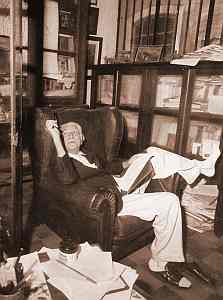
The famed Brazilian sociologist, Gilberto Freyre, asked me whether I based my story of generations of Cavalcantis on the secret unpublished journal of a Brazilian family. There were times during my five year odyssey on Brazil when I surely wished I possessed such a private diary. - There was no diary only the will to understand the Brazilian “thing.”
 
Professor Gilberto Freyre
Part of that understanding came from the journey I took over four months in 1981 traveling 20,000 kilometers through Brazil, almost entirely by bus. I visited the Casa Grandes; the big fazendas; the splendid beachfront apartments; the glass and concrete wonder of Brasília - the new El Dorado! I walked the sands of Porto Seguro; I rejoiced in the atmosphere of the Bahia; I stood in silence between sepulchral hills at Canudos. I climbed another hill, too, to gaze down on Vila Rica do Ouro Preto and imagine the handicapped sculptor Aleijadinho moving along Vila Rica's cobbled streets. I heard the muffled drum of tyranny presaging the last act in the drama of Tiradentes, martyr of Brazilian independence.
 
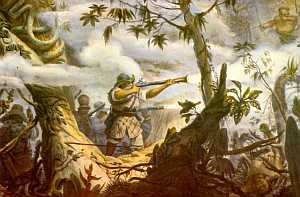
I wandered the sertão, the backlands, not just the wilderness beyond Bahia and in Amazonas but the sertão of the favelas of Recife and Rio de Janeiro. A literary bandeirante penetrating Brazil's past like those seventeenth century pathfinders, often feeling the thorny caatingas closing in on me but compelled to march forward like my hero, Amador Flores da Silva:
                               
To Amador, to his father, to all who traveled with them, there would be no expression more evocative, more meaningful than sertão. 'Backlands;' 'wild country;' 'the unknown forest;' 'hill, valley, river hidden by the mist of Creation;' 'place of thorn and desert;''brutal land without end' - sertão was all these and more. It started not beyond the next rise or across the river ahead but deep within the soul, a call to paradise or to hell...

The Bandeirante - Debret
 I kept a two hundred page journal on my four-month expedition across the length and breadth of Brazil. The scrawl on some pages vividly brings to mind a motorista, a bus driver, hanging on to the wheel as we sped through the caatingas. I remember triumphant cries of Asfalt! as we careened off a dirt road onto the hard-top. I remember glancing at a rear-view mirror and seeing a driver nodding off with half-closed eyes. I remember a girl in the seat next to me on her way to join a nunnery saying a prayer...               
 
Some glimpses follow from a journey that lies at the heart of Brazil. I'd begun my research travels in Portugal where I stayed for three months in Sintra, the 'glorious Eden' of Lord Byron. I tried teaching myself Portuguese and learned enough to decipher the written word, more or less, but spoke the language poorly. I wrote to half a dozen people in Brazil in advance but essentially landed at Bahia, Salvador without a single contact... Journeying through Brazil in 1981, I traveled through the heart of a nation in which the flame of freedom was newly lit after years of military dictatorship, my journal colored by the voices and emotions of the era.

The Woman with One Orange in Brasília

Brazil - The Making of a Novel - Part 7

More than the land, the Brazilian people themselves gave me the thousand and one insights I needed. Try to imagine a stranger coming to you and telling you he is going to write a novel about the entire history of Brazil. Five hundred years! A crackpot! Louco!
 
Bemused some were but with one solitary exception, a fiery young man of Manaus who flew into a rage and said an estrangeiro had no right to "steal Brazil's past,” save for this lone objector, I'd unstinting help and support from hundreds of people, some giving me days of their time, some only precious moments. An unnamed peasant woman standing next to me in a bus queue in Brasília and asking that I buy an orange for her sick child: I realized later that the orange was all the pair had for nourishment on a twenty-six hour bus trip.
 
I kept my daily journal during my trip and filled twenty notebooks. I pored over dozens of maps, paintings, photographs, absorbing and interpreting this mass of information as I went along. I was not bound by the same constraints as the historian, my book is a work of the imagination, but I was under an obligation to get the facts right. Foremost was an overriding desire to write a book that was accurate, balanced and avoided stereotypical images and over-simplifications that often mar the works of outsiders attempting popular fiction about Latin America.
 
Where my interpretations revise commonly-held views, I arrived at my conclusions only after the most critical thought.
 
My view of Brazilian slavery, for example, particularly the early centuries is harsher than what was usually portrayed.
 
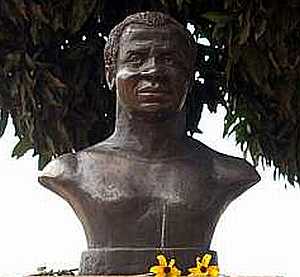
I did not study Brazilian slavery in isolation but looked at the Portuguese record in Mozambique and Angola, particularly the degradation of the Congo; the more I thought about it, the less I believed that the harsh Portuguese slaver in Africa could miraculously be transformed into a paragon in Santa Cruz. Palmares was the quilombo that made "headlines,” but how many others were there? Tens of thousands of runaway slaves do not suggest a benign regime of bondage.
 
"Ganga Zumba" of Palmares
             
I asked myself time and again, and not only with slavery: through whose eyes was the past beheld? Almost never in a colonial situation does one find anything but the official story neatly penned for bureaucrats thousands of miles away.
 
I'm no “frock coat” devoted to the literary salon. I do not write staring above the heads of the mass of people. I like to get my hands dirty “to recreate history,” as one reviewer of Brasil said, “almost entirely at ground level.”
 
While generations of fictitious Cavalcantis and Silvas populate my landscape, I took great pains to bring to center stage a host of characters drawn from the masses. Affonso Ribeiro and his wild clan; Nhungaza of Palmares and his grandson, Black Peter; Antonio Paciência, the mulatto, slave, voluntário in the Paraguayan War, so-called "fanatic" at Canudos, above all, “Antonio Paciencia-Brasileiro!” A few of the many as dear and vital to me as the great men of the earth in Brazil, past and present.
 
In the end, one writer's search for the soul of Brazil -- an honest and sincere attempt to understand "the Brazilian thing."