Showing posts with label Bahia. Show all posts

Canudos: Visions of a Hill where God's Thunderer Roared

 
Brazil - The Making of a Novel - Part 15
 
The Journey:  Uauá and Canudos, July 25 — July 27, 1980
 
 
Arrive at Uauá to find contact arranged via Antonietta out of town for a week but within minutes his wife arranges for a family friend to take me to Canudos tomorrow.
 
Amusing introduction to Uauá in Hotel Gonçalves run by a mother and her five daughters. As word spreads, I find myself seated at table with twelve women of the town come to observe estrangeiro.
 
Hotel floor is divided into cubicle-like rooms with walls open at the top, the occupant of the room next to me snoring away happily all night.
 
July 25 - July 27. Two and a half days with no journal entry, through lack of time and place. Earlier efforts on bus inadequate/difficult and besides, observations in the sertão grow predictably similar. Which, in a way, is the point about the sertão: vast, repetitive, soulless backlands, mile upon mile of caatingas, close-packed, mind encroaching. Step into it a few meters from the side of the road and you are lost. It enfolds and absorbs you. 
 
                                           
A brief visit to Canudos on Sunday provided as much as I wanted from the "present." There's a danger of getting put off track by too much modernism. I have strong impressions and ideas about Canudos/Antônio Conselheiro and my mind relates them to the 19th century. — What I behold in the 20th is a distraction and can only water down those impressions developed from reading and thinking. Preconceptions, if you will.
 
Curious aspect of Sunday was “Manoel” from Mozambique and left after independence. Within minutes of meeting him, he begged me not to mention “Moz” because, hand on heart, “it was too much for him,” and “all because of Samora Machel.” Manoel sells jewelry in the Brazilian sertão after “Moz” and Rhodesia (Zimbabwe,) where he was a linotype operator.
 
I don't know how many Manoels there are in this country but cannot see them doing anything to improve race relations Brazilian style. Though first he wanted to avoid the subject, Manoel had more and more to say as the day progressed. Stories like the man who disowned his mother because she wrote from Portugal saying that he should come back to the motherland, but “bring nothing that you took from the blacks.” According to Manoel, the man wrote back to Senhora X saying from that time he did not consider her his mother. Manoel personally does not wish to tread the soil of Portugal because of the “traitors.”
 
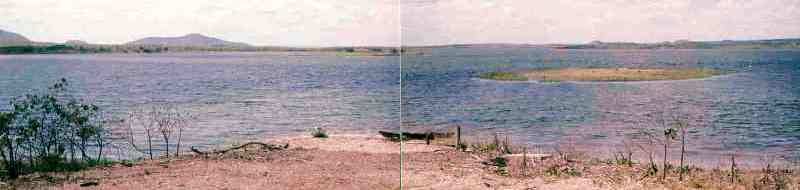
Even as I traveled toward Canudos I had visions of this barren, wasted sertão where a mystic's most fervent ramblings could take easy root. Interpretations of Glauber Rocha aside, the site of Canudos today lies beneath a barrage! A placid backwater with a small island where a few goats and sheep are rowed across to graze.
 
Canudos Brazil barrage
 
Locals suggest that the flooding of the valley was a political move, but I'm skeptical. It was, so far as I know, commenced in 1953. At that time, the kind of political consciousness/reappraisal/revisionist tendency we have today was in its infancy. Few outsiders would have taken symbol of Canudos seriously.
 
Nothing, absolutely nothing, to suggest that 20,000 people died in this small valley, nothing to bring back the echo of the small cannon from a nearby hill or roar of "God's Thunderer" from the larger hill beyond....
Canudos refugees, 1897
Anyway, I got what I wanted, a soul-filling understanding of the terrain, of the small towns of the time, of the people. Was surprised by Mrs. Gonçalves (of hotel) reciting word for word a prayer said by an old man who'd survived Canudos. Though few beyond the area remember it, Canudos is very much part of local folklore...

A Day at Modelo Mercado; A Night with "Decadent Aristocrats."

Brazil - The Making of a Novel - Part 11

The Journey: Salvador, Bahia  July 8 - July 11
 
Grab a few hours this a.m. for “office work.” Must allow more time for mental appraisal/assimilation of the barrage of information. Feel pretty secure with picture of Bahia for Tomás's arrival, Padre Inácio etc. (These are characters from my Outline for Brazil written earlier and based on book knowledge of Brazil and research in Portugal.)
 
Went to Antonietta's house in Sapateiros. Drunk, soiled beggar in doorway. We spent three hours poring over books from her four-thousand volume library. Especially impressed with her bandeirante material. Rest largely comprises works on churches, churches, churches. “Nossa Senhora” (Our Lady) are two words I'll never forget
 
In afternoon we go to the market, Mercado Modelo. An explosion of life Bahianese! Essentially a tourist/handicraft market, it has a restaurant attached to it. A vast meeting place where beer flows like water and people sing the songs of Bahia. For three hours, we eat and listen to the Afro-Brazilian rhythms. Again bringing a thought of the “release” from the slave quarters. (My South African heritage shames me in this blackest of all Bahiana cities!)
 
Historic Salvador, Bahia
with Mercado Modelo  Photo: Fernando Molina/Wikipedia

Back to Antonietta's house in the oldest quarter and for four-and-a-half hours she sits reading my synopsis. Her verdict is ENTHUSIASTIC! And a good deal more! Few Brazilians know the history as ELU, she says. Encouraging.
 
For an hour afterwards, we sit talking about the political realities, '64 to present. Troubling. She explains background of the opposition PF (Popular Front) to which she belonged aimed at grassroots change, alongside PCdoB(Communist Party, Maoist) and PCB (old Prestes group, pro-Soviet.) Also active were Focustas (from “focus”) who became most radical element. After congress, PF merged with PCdoB to work for reforms.
 
Pro Democracy Demonstration in Brazil 1984
Photo: Jorge Henrique Singh via Wikipeida

She talks of strong-arm methods/disappearance of friends etc. All very similar in most respects to South African situation.
 
Not clear of objectives, though main purpose “to improve condition” of the people. That's too broad for my liking. In recent times, things appear to have eased up but not clear to what extent. She stresses role of the Church. Even though it may not be evident in outward ways, e.g. church attendance, the Catholic spirit is fundamental to Brazilians.
 
Antonietta refers to 1 percent of population being truly “educated,” traveled etc. including those like herself whom she describes as “decadent aristocrats.”
 
Our talks end at 1.40 A.M. I've decided to move to Porto Seguro on Monday morning; Brasília next Thursday.

Landing in Salvador - Princess Paraguaçu, Two Abandonados, a Cockroach and a Prayer

Brazil - The Making of a Novel - Part 9
 
The Journey; Salvador, Bahia, July 7 - July 14
 
(Landed at 3.40 a.m.) Early morning arrivals are disastrous, especially when coupled with congress of six thousand medicos starting tomorrow. Good-intentioned cab driver drops me at sea front. Gray sky, showers, pre-dawn humidity. First hotel full, second $50 a night. Find myself walking back toward Centro after stop for Coke at kiosk where my “jacket Americano” is main interest. Also my $1 note for Coke. Scrawny woman creeping in and out of shadows to beg a cigaretta.
 
Finally made it via VW taxi to “Hotel Imperial” in Centro at 6.15 and get room at 900 cruzeiros (91cr. to $1.) A benign fleapit. Shocking pink walls. Cockroach at eye level when I wake five hours later. Noise. Deadly shower system (loose electric wires dangling from heating unit) but probably a lot better than what lies ahead and able to keep me within my $30-a-day budget. (And, as usual, contradicting LdJ's observations on “horribly expensive Brazil.”) I had perfectly adequate dinner of chicken, feijoas, rice, salad, beer and tip for 330cr. ($3.50)
 
Salvador Brazil harborFirst impressions of Salvador come from the large black population. Were this not Brazil, you could expect to awake in a West African seafront town.
 
First encounter with abandonados particularly memorable in visage of two little girls who'd steal many a U.S. heart. Sad if one considers all the implications beyond the empty soda tin thrust toward you but yet not pathetic.
 
There was a liveliness, a vivacity, as in their response when a customer at the snack bar ordered a glass of water which he tossed over them! In contrast, a young boy who was approached stopped to talk with the prettiest of the two girls, gave her a fond clasp on her shoulder - no money - before going on his way.
 
The urgency of getting down to serious work after the Portuguese experience impresses upon me. By 4.30 I've spent two and half hours with the Bahia information people who seem much more on the ball. Arrange to spend day with Henriques Caldeira. I'm impressed with the “sense of history” shown by these first contacts: Dona Linda Conde, who spoke of a plantation that's been in her family for 250 years; Henry who is Jewish and traces his ancestry back to the Dutch/Portuguese connection and Dona Gildene who is a great-great-great + granddaughter of Paraguaçu, the Indian princess who married Caramuru. Dona Gildene also has Dutch ancestry. (Must check influence of Dutch influence down here.)
 
This first brief foray suggests Bahia is font of Brazilian culture. Am also beginning to realize importance of maintaining this journal to remember all that comes at me and to have this “self-communication” each evening. This self-imposed silence for one so garrulous as me is unusual!
 
I go to bed quietly hopeful and prayerful. Have, as I did in Portugal with the likes of Serrão, prepared a list of “interests.” Pray God that they come up to expectations. I close Day One with a sense of cautious optimism.
 
Princess Paraguaçu and Caramuru


A Gringo in the White Forest of Brazil

Brazil - The Making of a Novel - Part 6
 
From Porto Seguro to Brasília, a tremendous leap in time and imagination that was to prove fateful. Though I did not know it then, I was being handed one of the keys to my vision of Brazil, the metaphor of Brasília and El Dorado. In his review of Brazil , the eminent Brazilian literary scholar, Professor Wilson Martins wrote:   
 
What we have in front of us is the Brazilian national epic in all its decisive episodes — the indigenous civilization and the El Dorado myth that they themselves created and supported, passing it on to the hallucinated imaginations of the conqueror; the discovery and domination of the North-East; the Bandeiras and geographical expansion; the gold rush and nationalist feeling present, not only in the struggle against the Dutch but also the Inconfidência Mineira; the Royal Family's arrival and the Independence; the Second Reign and the war with Paraguay; the Abolition and the Republic — everything converging like the segments of a rose window in that reborn and metamorphosed myth that is Brasília, symbol of the proclaimed territorial integrity and, not without reason, with the expeditions that expanded to the south and to the west on the pretext of capturing Indians and searching for the “Golden Fleece.
 
From Brasília, I traveled to Piauí and the sertão of Bahia, to Uauá and Canudos. Like so many other stops along my journey, I was there to brood over the past. I already had the broad picture but needed the innumerable small details to fill my canvas.
 
To have studied Euclides da Cunha's Rebellion in the Backlands and other sources was one thing, but go alone into the thorny caatingas ("White Forest",) walk for hours with the sun burning down on you, rest upon that stony earth, not a little fearful that you're totally lost — it takes little to imagine the hell that raged at Antônio Conselheiro's New Jerusalem.
 
Site if Canudos, as it appeared after diversion of Vasa-Barris river.
Locals believed it was intentionally flooded by government
 
My next halt was at Recife and Olinda where I spent three weeks, mostly under the guidance of Gilberto Freyre's Joaquim Nabuco Foundation. With their help I found my valley of Santo Tomás and my imaginary town of Rosário, the locales for my fictitious family of Cavalcantis.
 
From Recife I traveled to Belém and embarked upon the Amazon, five days of brooding along the river sea to Manaus and on to Porto Velho. What I had in mind in journeying the wilderness was not so much Nature's glories but the men who were first to venture there: the bandeirantes. Nowhere but in those lonely tracts of forest could I get a sense of the enormity of their undertakings, their indefatigable spirit and courage.
 
From Porto Velho and Cuiabá, I headed south to Rio, São Paulo and Minas Gerais. After so many weeks it was a shock, traveling out of the backlands to the great cities. I was as bewildered and lonely as the sertanejo who goes south, but even as I felt this I knew my intuition to start my journey in the north had been right. Had I plunged into Rio or São Paulo at the start, I could've been drowned but up north I was able to absorb the Brazilian "thing" in small doses, day by day.
 
This is a very real problem in developing a book like mine, for in so short a time no outsider can possibly hope to get more than a superficial look at a great city like Rio de Janeiro. Which is why when I got down to writing Brazil I placed my two families beyond the cities, the Cavalcantis on Engenho Santo Tomás near Rosário and the da Silvas of bandeirante ancestry at the fictional Itatinga on the Rio Tietê, their worlds a microcosm of the greater Brazil beyond.
 
Glimpses of the Casa Grande, Pernambuco, Brazil