Showing posts with label Gilberto Freyre. Show all posts

In the Shadow of the Casa Grande and the Senzala - Meeting with Gilberto Freyre

 
Brazil - The Making of a Novel - Part 22

The Journey - Recife -  July 28 - August 13, 1980

August 11 On bus again! Left Recife last night for 33-hour trip to Belém. Longest haul to date made longer by one hour roadside delay. We've run of gas — eventually bought from a passing truck.


Missed August 8-10 entries. Stayed to await interview with Gilberto Freyre. I was able to bounce most of my ideas off him and with no exception, they were sound. Pleased that some of the more controversial leads I suggest did not put Freyre off — “No evidence of that but not totally unlikely.”
 
For example, my suggestion that there could be a link between Pernambucanos ("Cavalcantis") and Inconfidência Mineira (Da Silvas). Look to a Masonic link, Freyre suggests. And, for example, the suggestion that there were black slaves present from the beginning, brought from Portugal. He likes the idea though, of course, stressed early importance of the Indians, especially the women.
 
(c) Gilberto Freyre Foundation  Professor Freyre in Private Study in 1980s
Professor Gilberto Freyre
Image courtesy Joaquim Nabuco Foundation

At 82, Freyre is a sprightly man, quick-witted, especially against the onslaught of ELU. I see no reason (as some do) of revising his theories, update yes, but if Pumaty is any example, the Case Grande idea holds up today as ever. What criticism I did hear from Freyre was either irrelevant or only related to small issues. [Note: This journal is, of course, separate from my interview notebooks that go into far more detail about my meeting with Professor Freyre and others. In many instances, too, major sources like Freyre were given a copy of my Outline for Brazil in advance and had a good idea of my thinking.]
 
Keeping this journal is a habit I am beginning to see as indispensable. The images and experiences are so different, so much a shock of the new or the familiar refound — that without recording them it would be impossible to remember all. In Brazil, each new day is one of discovery!
 
On Saturday night, a 9.30 visit with Amalia and her vast family, ten brothers and sisters, all older, twenty-eight nephews etc. Afterwards to a music bar and home by 4.30 a.m. Looked to quiet Sunday and started out Boa Viagem Beach Recifeat Boa Viagem beach, then to Olinda but on way back to hotel bumped into my friend Black Jimi and got home 2.30 a.m. Afternoon interview with Freyre and on bus at 6.15 p.m.
 
Amalia's family represent the ultimate extended family and, with experience of Antonietta in mind, typical of the grand old families of Brazil. Something I need to create for the Cardosos (Cavalcantis) of 1960/1970. Amalia's family is not only a patriarchal but a political unit with connections at every level, federal, state, local. Her references to various members invariably brings up one or another coronel- type connection.
 
Won't forget entering house and meeting family, seemed to be dozens of them, including Lima Filho. It would've been impossible to remember all their names. Event was the birthday of one of the twenty-eight nephews and nieces. Head of the family is mother, 82, and Amalia at 37 is the youngest child. Amalia's father was a prominent opposition member and owner of five farms, plus Lord knows what more. — All gathered round on patio after dinner for sing song to accompanied by an excellent guitarist.
 
What some had to say was often directly out of a South African situation: members of a privileged class and their involvement that would fit perfectly into a Progressive Party mold. Some liked to distance themselves from the diamond-bedecked Dona of Pumaty but were really speaking the same language. Too much pobre (poverty) agreed, but as I've seen so many times in Brazil, such social consciousness is voiced in one breath and in the next, they go on to tell you about a) the beach apartment b) the beach house c) the farm in the sertão, replete with many jokes about the people there, not racialistic though in similar vein.
 
As I told Gilberto Freyre, one of these days someone should do a comparative study between South Africa and Brazil. Could be illuminating.

Some thoughts on Racism and Poverty in Brazil

Brazil - The Making of a Novel - Part 18

The Journey - Recife  July 28 -- August 13, 1980
 
August 2: Today was spent at a Benedictine monastery, Monasteiro São Bento, in company of Edson Nery, as guest of Dom Basilio Penido and Dom Felix Bruneau. For one who has often stayed a distance from the church, a day in the company of the monks was a deeply moving experience.
Olinda Brazil Sao Bento Church
Monasteiro São Bento
What does one on the outside know about monks, cloisters, liturgy, Gregorian chants? Painfully little, so that you are surprised to find that life is very normal. Started at 10:30 and attended various offices with the monks, 1st at 10 to 12, then vespers at 5:30, mass (1/2 plus communion), then completa at 8.00 p.m.
 
Was surprised in talks with Dom Penido and Dom Bruneau to find just how involved they were with the world, though still maintaining aspects of the past as in their cells. Took my afternoon rest inOlinda Brazil Sao Bento Church altar a cell prepared for me: traditional monastic term for what is really a large room bereft of worldly possessions, a bed, bureau and two chairs. Deeply moved during various services by the chants, psalms sung by choir, the melodiousness of their voices echoing in lofty 1761 church, the intonations reaching deep within oneself.
 
Dr. Nery is a wonderfully compassionate, aesthetic man who undoubtedly belongs among the brothers. Somewhat difficult to speak to because it seems he is in process of withdrawing from the world we know and may well enter the monastery.
 
Today was a great contrast to Saturday's event. First drove with Amalia Correa around Recife and Olinda. I now understand the topography, Tamaraca, Iguaraçu, Pão Amarelo, Olinda, Recife, Guarapes are no longer mere names. I look forward to returning to my books and re-reading material with a deeper understanding.
 
Saturday night was yet another contrast with Roberto Motta, religious anthropologist and his gay theatre/art friends. They drink like fishes, hug each other fervently, and between this, argue politics.
 
Silvio, a black man, proves most illuminating. With Roberto, he's off to a Brazil-Africa conference in Rio on Monday, the first of its kind. Silvio makes an interesting point about racism: The world laughed when Emperor Bokassa (Central African Republic) was crowned calling him “a stupid black etc.” But the world rejoices with Charles and Diana...
 
Ended evening at gay bar in Casa Forte with more political talk, little of which I could follow except to realize that the 25-35 generation of intellectuals in Brazil is seething, all attention directed toward the November 15, 1981 elections, the first democratic elections since 1964.
 
I'm beginning to see why military presence is so obvious in Pernambuco. There is an atmosphere of rebelliousness about the place.
 
At so many levels beyond the “haves” and the “playground” people, there is chronic poverty.
 
A dramatic example of this is Recife Yacht Club: To get to it you drive for miles through “Brasília Teimoso,” a favela that started as a squatter camp at the same time as the new federal capital. The streets are pools of filthy water, no sewers, little lighting, a mix of permanent houses and shacks.
 
Bridge to God's Island, Recife 2014
Behind the Façade, This Is God’s Island
Keep encountering comments and evidence of racism and color differentiation. As Silvio said, he asked a top general why there were so few black generals in Brazil. Man replied that no more than fifty black people in senior posts in the country.
 
I wonder how Gilberto Freyre reconciles his interpretation of a “New Man” in the tropics with the reality expressed by so many people I meet of racism in Brazil - of the innumerable “classifications” of color, once relatively harmless and superficial but assuming a more serious nature as jobs get scarcer, poverty worsens and color deepens. This all strikes this ex-South African observer sharply. Brings to mind, too, the confusingly contradictory attitude of the South African Progressive—type.
 

Stepping out in the Tropics of Brazil

Brazil - The Making of a Novel - Part 17

The Journey - Recife  July 28 -- August 13, 1980
 
July 30: Not always possible to maintain an enthusiastic “high” - Once in a while, as now, it slips and you feel a real stranger.
 
Edson Nery, library “scientist” at the Fundação Joaquim Nabuco, a lay Benedictine monk, could not be nicer but has no concept of what it takes to write a book like Brazil. Yesterday was spent poring over museum collection - useful; today was passed in Foundation's library with excellent old engravings, also useful but dangerous:
 
I have to get out, experience and “look.” U.S.A. has best libraries in the world and when I'm back home I can sit in them for as long as is necessary. Here, I've got to see not pages but people. And the past insofar as one can separate present sights and scenes from what has been.
Recife, Pernambuco, Brazil
Edson is a dear librarian of special repute, no doubt, but too close to his books and eleven cats to see the finger-dirtying reality. A contemplative man, he himself says, grown pessimistic about the world and seeking his main solace in Sunday hours spent with the Abbot and Prior of the Monastery at Olinda.
 
So, though the day was spent in hard research and I got many visual images of use, I'm wary of over-involvement with the Fundação. Maybe they will come up with an engenho to visit and, of course, there's my interview with Gilberto Freyre himself. But I'm determined that these hours shall not be “book-bent.”
 
July 31: Once again proved that to accomplish things in the tropics you have to step beyond the lethargy so easily induced.
 
Day started with call to Edson Nery at home complaining very indirectly about lack of cooperation. Well, aside from suggestion that I go back to the library to look at more pictures this morning as planned, Edson showed clear understanding of my needs. A car will be arranged!
 
And it is: In afternoon my Recife travels begin in earnest. I'm also invited to dinner tomorrow night with anthropologist Dr. Robert Motta and friends
 
Afternoon visit to Iguaraçu, site of first church in Brazil, built 1535/plus Jesuit church/and third church atop hill. All vital to story since it is vicinity between here and Recife proper that I will place Cardosos (“Cardoso” family later changed to “Cavalcantis.”) Have to find way to move to second locale. Will probably be after Dutch invasion with re-start further away.
 
Convento de São Francisco - Olinda  Vladiney Pimento/Wikipeida
 
My guide, Amalia Correa, proves as fascinating as the historical aspect. Her brother was Minister of Agriculture under Goulart. Father was federal deputy from Pernambuco representing Bom Jardim to the north. Family is obviously one of the older political ones with classic coronel (Cardoso?)and wide connections.
 
Memorable anecdote of Amalia's sister who teaches at a favela in the evenings: "Simple things that people will understand like words for food etc. She explained 'meat.' Woman in class responded: 'Oh, I know meat but it is so long since I have tasted it.'"
 

"A Life of Constant Humiliation in Recife"

Brazil - The Making of a Novel - Part 16

The Journey - Recife  July 28 -- August 13, 1980
 
First impressions of Recife are grim and I suspect that they're not going to be altered as easily as Brasília. - Met my first Brasília detractor, Edson Nery de Fonseca. He lived there for twenty years, was Librarian of House of Representatives and calls Brasília “a crime against humanity.”
 
What I've seen of Recife seems to earn that appellation. Whereas we in “developed America” flinch at abandoned dogs and cats, here you have to get used to droves of abandoned children, abandoned people. I remember in Rhodesia (Zimbabwe) some years ago, remarking on the number of people, young especially, hanging around the streets of Bulawayo during work hours: Here was the real “security” risk.
 
Recife is a hundred times worse. Hundreds and hundreds of kids, adults, beggars with nothing to do; hundreds of others pathetically trying to make an honest living by selling anything from plastic toy planes to graters, packs of envelopes, sidewalk foodstuffs... Many gravitate to Recife from the backlands seeking a new life and, I suspect, invariably meet disappointment.
  
As Luiz “Black Jimy” said yesterday: “It is a life of constant humiliation.”
 
Alongside this cruel, brutal poverty is first real evidence of The Military. In Salvador, Brasília, in countless little villages, you see a few police/militia but here the presence is overwhelming. Traveling out to the Institute (Fundação Joaquim Nabuco) you pass base after base of one or another military establishment.
 
My immediate response is that this is a manifestation of government awareness of past rebelliousness on part of Recife/Pernambuco, traditionally a point of fire through every regime. Walk the streets and you can easily understand the “nervousness”...
 
As anyone who knows me will accept, I am not one to creep into a protective shell. I love exploring a new city by day/night, really “exploring” it and its people. Here, for first time, I feel a need for caution. Step out there, let things carry you along, and I sense real trouble. There are thousands in real need and desperate: One lone “American tourist” is a quick mark. (Like the licensed bandit of a taxi driver who charged me 400 cruzeiros for what should've been a 80cr. ride. Made up for it though, with bus ride x 18cr. = 200 taxi trip to Joaquim Nabuco Foundation.)
 
Difficult to believe that twenty-two days have elapsed since my arrival. Have covered thousands of miles, met dozens of people, many beyond the mere acquaintance phase. Toughest part of the trip is breaking fresh ground each time, going through the long introductory phase, establishing credentials. 

The whole day today was spent in this activity. But it's vitally important to opening up a city, situation for research. - Go slowly, let them understand you, above all believe in you, and so win their confidence. - I overheard Nery at lunch telling Fernando Freyre, Gilberto's son, “He is a serious student of Brazil.”
 
Got my first glimpse, at Museum of Man in the North-East, of artifacts of the sugar plantations: sadly impressive preponderance of equipment to keep slaves in their place. Worst was a device called "The World Turns” which would make a man into a ball-like figure binding leg and arms.
James S. Handler and Michael L. Tuite Jr.
(c) 2006 Virginia Foundation for the Humanities and University of Virginia
 
Edson Nery liked my description of Brasília as the ultimate "fazenda" and example of the coronel/latifundia way of life.
 
"Anna"(not real name,) a guide at Museum is from one of old families with an engenho (plantation) to the south. She expressed to this stranger all manner of statements about the poor summed up by: “It's the will of God.” The same is said by others in so many places...
 
Things like that make me realize just why all my traveling in the past is so important: To write a book for the world you have to know the world. You have to have a comparative base to work from, a benchmark against which you can “rub” your opinions and see how they come up.
 
Prosaic note: Lord, the food is monotonous: Steak ABCD/ Frango (chicken) ABC/Fish ABC/ That's it, day after day. For a week now I've had file (fillet)/contra file + beer + coffee!


A Gringo in the White Forest of Brazil

Brazil - The Making of a Novel - Part 6
 
From Porto Seguro to Brasília, a tremendous leap in time and imagination that was to prove fateful. Though I did not know it then, I was being handed one of the keys to my vision of Brazil, the metaphor of Brasília and El Dorado. In his review of Brazil , the eminent Brazilian literary scholar, Professor Wilson Martins wrote:   
 
What we have in front of us is the Brazilian national epic in all its decisive episodes — the indigenous civilization and the El Dorado myth that they themselves created and supported, passing it on to the hallucinated imaginations of the conqueror; the discovery and domination of the North-East; the Bandeiras and geographical expansion; the gold rush and nationalist feeling present, not only in the struggle against the Dutch but also the Inconfidência Mineira; the Royal Family's arrival and the Independence; the Second Reign and the war with Paraguay; the Abolition and the Republic — everything converging like the segments of a rose window in that reborn and metamorphosed myth that is Brasília, symbol of the proclaimed territorial integrity and, not without reason, with the expeditions that expanded to the south and to the west on the pretext of capturing Indians and searching for the “Golden Fleece.
 
From Brasília, I traveled to Piauí and the sertão of Bahia, to Uauá and Canudos. Like so many other stops along my journey, I was there to brood over the past. I already had the broad picture but needed the innumerable small details to fill my canvas.
 
To have studied Euclides da Cunha's Rebellion in the Backlands and other sources was one thing, but go alone into the thorny caatingas ("White Forest",) walk for hours with the sun burning down on you, rest upon that stony earth, not a little fearful that you're totally lost — it takes little to imagine the hell that raged at Antônio Conselheiro's New Jerusalem.
 
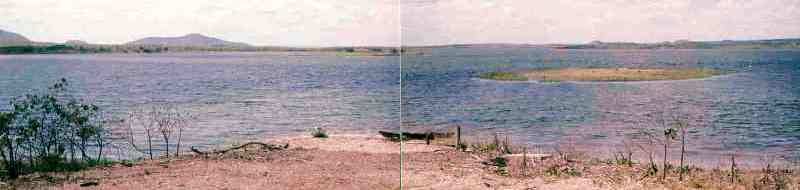
Site if Canudos, as it appeared after diversion of Vasa-Barris river.
Locals believed it was intentionally flooded by government
 
My next halt was at Recife and Olinda where I spent three weeks, mostly under the guidance of Gilberto Freyre's Joaquim Nabuco Foundation. With their help I found my valley of Santo Tomás and my imaginary town of Rosário, the locales for my fictitious family of Cavalcantis.
 
From Recife I traveled to Belém and embarked upon the Amazon, five days of brooding along the river sea to Manaus and on to Porto Velho. What I had in mind in journeying the wilderness was not so much Nature's glories but the men who were first to venture there: the bandeirantes. Nowhere but in those lonely tracts of forest could I get a sense of the enormity of their undertakings, their indefatigable spirit and courage.
 
From Porto Velho and Cuiabá, I headed south to Rio, São Paulo and Minas Gerais. After so many weeks it was a shock, traveling out of the backlands to the great cities. I was as bewildered and lonely as the sertanejo who goes south, but even as I felt this I knew my intuition to start my journey in the north had been right. Had I plunged into Rio or São Paulo at the start, I could've been drowned but up north I was able to absorb the Brazilian "thing" in small doses, day by day.
 
This is a very real problem in developing a book like mine, for in so short a time no outsider can possibly hope to get more than a superficial look at a great city like Rio de Janeiro. Which is why when I got down to writing Brazil I placed my two families beyond the cities, the Cavalcantis on Engenho Santo Tomás near Rosário and the da Silvas of bandeirante ancestry at the fictional Itatinga on the Rio Tietê, their worlds a microcosm of the greater Brazil beyond.
 
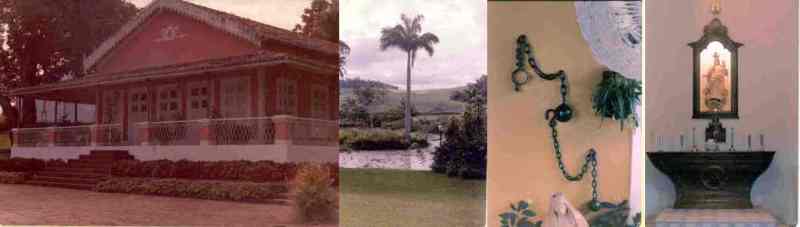
Glimpses of the Casa Grande, Pernambuco, Brazil