Showing posts with label slavery. Show all posts

Brazil - A history in pictures


An online guide with a wealth of photos and illustrations giving a unique insight into the history of Brazil.

Links to the Illustrated Guide to Brazil can be found at the end of each section of the digital edition of the epic of Brazil enhancing the reader's enjoyment of a spellbinding saga "with the look and feel of an enchanted virgin forest, a totally new and original world for the reader-explorer to discover."

Brazil is the first work of fiction to depict five centuries of a great nation's remarkable history. With a stunning cast of real and fictional characters, this unforgettable epic unfolds in South America, Africa and Europe.


Brazil has a large cast of characters. The Cavalcantis of Santo Tomás and the da Silvas of Itatinga and most of the incidents involving these families are fictional. Aruanã, Secundus Proot, Black Peter, the Ferreiras, Patient Anthony, Armand Beauchamp, Henrique Inglez, Bábá Epifánia – these, too, are imaginary characters. 

King Afonso I of the Kongo; Nóbrega and Anchieta; Tomé de Sousa; Mem de Sá; Raposo Tavares; Johan Maurits; “Ganga Zumba;” Pombal; Tiradentes; Pedro II; Francisco Solano López; Eliza Alicia Lynch; Joaquim Nabuco; Anthony, the Counselor; Juscelino Kubitschek; Vilas Boas; Herbert “Betinho” de Sousa – these are real characters and what is said of them relates to recorded history.


Brazil - The epic of a great nation

Brazil, Land of Contrasts - The Sublime and the Ridiculous

Brazil - The Making of a Novel - Part 21
 
The Journey - Recife -  July 28 - August 13, 1980
 
August 7 Missed yesterday's entry: up at 6.30 to travel to Pumaty sugar mill and refinery, back 8 p.m. preparing for interview with Gonçalves de Mello till 10.30 leaving little time for notes.

Started today with visit to the state tourist authority, which for two days has been trying to meet a simple request: to obtain a map of the state. Result. “Is not possible.” Brazil, the sublime and ridiculous, the contrasts!

Where else would you, one day, visit one of the most sophisticated sugar estates in the world that not only grows 7,000 hectares of the stuff but mills it through a five-mill line up and then refines it for export... And the next day, encounter a state tourist authority that is unable to provide a simple map of the state!
Pumaty Engenho, Casa Grande, Pernambuco
 
Pumaty Engenho, chapel, Pernambuco
 
Pumaty Engenho, private chapel, Pernambuco
On Pumaty estate, there's a beautifully preserved Casa Grande, the pride of the owner. As I sat with him and his elegant wife, and the social worker they had employed to help their employees, I could not but glance at the wall behind them: dangling from an iron spike, prominently on display, was an slave ball and chain. Oh, the contrasts.
 

Slavery, relic - Pumaty, Pernambuco

This morning spent at Baptist seminary examining journals of last century Baptist missionaries. Rather simplistic though see that Taylor, one of earliest Baptist missionaries, actually notes occurrence of Canudos with somewhat confused interpretations. But more important was Baptist reports of the degree of intolerance present prior to the coming of the Republic and separation of State/Church. Repeated reports of attacks on missionaries, of anti-Protestant moves inspired by local priests, of Bible burnings etc.

The Baptists get vitriolic in their condemnation of the RC church as idolatrous, pagan etc. with numerous references by Taylor to idol worship in form of saints etc. Today the Baptists have 500,000 followers, as against 90 percent of 120 million Catholic, which shows the progress...

Day 31 of the trip. How far from that evening so long, long ago when I left Sintra and family at the station.

My confidence continues to soar. Today's interview with João Gonçalves de Mello, Recife's foremost historian, was typical. Impressed by my knowledge of Brazilian history. Ran basic outline of my story against him and 90 percent stood up without critique!

Realize that aside from the setting, atmosphere I am getting on the trip and basic groundwork already complete, when I get back I am going to have to read my way into the fine details of every traveler, every translation I can lay my hands on. This can be an ongoing process as the book develops, so that I'll have the background pretty well locked up. And then comes the “imagination!”

Note: TV reporting Bolivia's 195th coup!
BRAZIL - The Epic of a Great Nation

The Woman with One Orange in Brasília

Brazil - The Making of a Novel - Part 7

More than the land, the Brazilian people themselves gave me the thousand and one insights I needed. Try to imagine a stranger coming to you and telling you he is going to write a novel about the entire history of Brazil. Five hundred years! A crackpot! Louco!
 
Bemused some were but with one solitary exception, a fiery young man of Manaus who flew into a rage and said an estrangeiro had no right to "steal Brazil's past,” save for this lone objector, I'd unstinting help and support from hundreds of people, some giving me days of their time, some only precious moments. An unnamed peasant woman standing next to me in a bus queue in Brasília and asking that I buy an orange for her sick child: I realized later that the orange was all the pair had for nourishment on a twenty-six hour bus trip.
 
I kept my daily journal during my trip and filled twenty notebooks. I pored over dozens of maps, paintings, photographs, absorbing and interpreting this mass of information as I went along. I was not bound by the same constraints as the historian, my book is a work of the imagination, but I was under an obligation to get the facts right. Foremost was an overriding desire to write a book that was accurate, balanced and avoided stereotypical images and over-simplifications that often mar the works of outsiders attempting popular fiction about Latin America.
 
Where my interpretations revise commonly-held views, I arrived at my conclusions only after the most critical thought.
 
My view of Brazilian slavery, for example, particularly the early centuries is harsher than what was usually portrayed.
 
I did not study Brazilian slavery in isolation but looked at the Portuguese record in Mozambique and Angola, particularly the degradation of the Congo; the more I thought about it, the less I believed that the harsh Portuguese slaver in Africa could miraculously be transformed into a paragon in Santa Cruz. Palmares was the quilombo that made "headlines,” but how many others were there? Tens of thousands of runaway slaves do not suggest a benign regime of bondage.
 
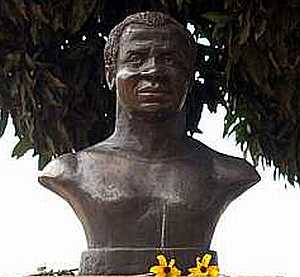
"Ganga Zumba" of Palmares
             
I asked myself time and again, and not only with slavery: through whose eyes was the past beheld? Almost never in a colonial situation does one find anything but the official story neatly penned for bureaucrats thousands of miles away.
 
I'm no “frock coat” devoted to the literary salon. I do not write staring above the heads of the mass of people. I like to get my hands dirty “to recreate history,” as one reviewer of Brasil said, “almost entirely at ground level.”
 
While generations of fictitious Cavalcantis and Silvas populate my landscape, I took great pains to bring to center stage a host of characters drawn from the masses. Affonso Ribeiro and his wild clan; Nhungaza of Palmares and his grandson, Black Peter; Antonio Paciência, the mulatto, slave, voluntário in the Paraguayan War, so-called "fanatic" at Canudos, above all, “Antonio Paciencia-Brasileiro!” A few of the many as dear and vital to me as the great men of the earth in Brazil, past and present.
 
In the end, one writer's search for the soul of Brazil -- an honest and sincere attempt to understand "the Brazilian thing."