Showing posts with label Brazil travel. Show all posts
Brazil - A writer in search of the heart and soul of a great nation
I searched for the story of Brazil for five years, a literary pathfinder wandering in quest of the untold saga of the Brazilians and their epic history.
In these pages, I share my mighty journey of twenty thousand kilometers across the length and breadth of Brazil in 1981. I traveled through the heart of a nation in which the flame of freedom was newly lit after years of military dictatorship, the journal I kept colored by the voices and emotions of the era.
I explore the exhaustive processes that go into the making of a novel with a first draft of three-quarters of million words written in the old-fashioned way, by hand. I reveal the early genesis of my ideas for plot lines and characters, the detailed planning of my outline.
Of all the accolades a writer could hope for at the end of an epic work like Brazil none brought more joy than a simple question asked by the famed Brazilian historian and sociologist Gilberto Freyre.
"I should like to know if Uys had an unpublished jornal intime of a Brazilian family?"
There was no private journal, just the will to understand the Brazilian "thing" and a passion for writing and storytelling, which lies at the heart of every good novel.
Brazil - The epic of a great nation
Landing in Salvador - Princess Paraguaçu, Two Abandonados, a Cockroach and a Prayer
Brazil - The Making of a Novel - Part 9
The Journey; Salvador, Bahia, July 7 - July 14
(Landed at 3.40 a.m.) Early morning arrivals are disastrous, especially when coupled with congress of six thousand medicos starting tomorrow. Good-intentioned cab driver drops me at sea front. Gray sky, showers, pre-dawn humidity. First hotel full, second $50 a night. Find myself walking back toward Centro after stop for Coke at kiosk where my “jacket Americano” is main interest. Also my $1 note for Coke. Scrawny woman creeping in and out of shadows to beg a cigaretta.
Finally made it via VW taxi to “Hotel Imperial” in Centro at 6.15 and get room at 900 cruzeiros (91cr. to $1.) A benign fleapit. Shocking pink walls. Cockroach at eye level when I wake five hours later. Noise. Deadly shower system (loose electric wires dangling from heating unit) but probably a lot better than what lies ahead and able to keep me within my $30-a-day budget. (And, as usual, contradicting LdJ's observations on “horribly expensive Brazil.”) I had perfectly adequate dinner of chicken, feijoas, rice, salad, beer and tip for 330cr. ($3.50)
First encounter with abandonados particularly memorable in visage of two little girls who'd steal many a U.S. heart. Sad if one considers all the implications beyond the empty soda tin thrust toward you but yet not pathetic.
There was a liveliness, a vivacity, as in their response when a customer at the snack bar ordered a glass of water which he tossed over them! In contrast, a young boy who was approached stopped to talk with the prettiest of the two girls, gave her a fond clasp on her shoulder - no money - before going on his way.
The urgency of getting down to serious work after the Portuguese experience impresses upon me. By 4.30 I've spent two and half hours with the Bahia information people who seem much more on the ball. Arrange to spend day with Henriques Caldeira. I'm impressed with the “sense of history” shown by these first contacts: Dona Linda Conde, who spoke of a plantation that's been in her family for 250 years; Henry who is Jewish and traces his ancestry back to the Dutch/Portuguese connection and Dona Gildene who is a great-great-great + granddaughter of Paraguaçu, the Indian princess who married Caramuru. Dona Gildene also has Dutch ancestry. (Must check influence of Dutch influence down here.)
This first brief foray suggests Bahia is font of Brazilian culture. Am also beginning to realize importance of maintaining this journal to remember all that comes at me and to have this “self-communication” each evening. This self-imposed silence for one so garrulous as me is unusual!
I go to bed quietly hopeful and prayerful. Have, as I did in Portugal with the likes of Serrão, prepared a list of “interests.” Pray God that they come up to expectations. I close Day One with a sense of cautious optimism.
![]() |
| Princess Paraguaçu and Caramuru |
The Epic of Brazil on Amazon Kindle
“Through the
lives of two powerful families, Brazil depicts five turbulent centuries
in the history of a remarkable land. From colony to kingdom, from empire to
nation, Brazil is filled with memorable people living through one of the
great adventures in human history.”
A
masterpiece! Brazil has the feel of an enchanted virgin forest, a
totally new and original world for the reader-explorer to discover. L' Express, Paris
Pulsing
with vigor, this is a vast novel to tell the story of a vast country. Uys recreates
history almost entirely "at ground level," through the eyes and
actions of an awesome cast of characters. Publishers Weekly
Uys
has accomplished what no Brazilian author from José de Alencar to Jorge Amado
was able to do. He is the first outsider with the total honesty and sympathy to
write our national epic in all its decisive episodes. Descriptions like those
of the war with Paraguay are unsurpassed in our literature and evoke the great
passages of War and Peace. Wilson Martins, Jornal
do Brasil
The Kindle edition comes with a free Illustrated Guide to the Novel.
Brazilian Adventure - A Call to Paradise or to Hell
Brazil - The Making of a Novel - Part 8
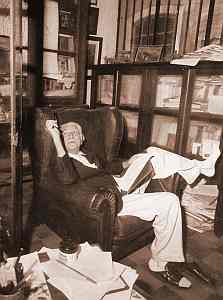
The famed Brazilian sociologist, Gilberto Freyre, asked me whether I based my story of generations of Cavalcantis on the secret unpublished journal of a Brazilian family. There were times during my five year odyssey on Brazil when I surely wished I possessed such a private diary. - There was no diary only the will to understand the Brazilian “thing.”
| Professor Gilberto Freyre |
Part of that understanding came from the journey I took over four months in 1981 traveling 20,000 kilometers through Brazil, almost entirely by bus. I visited the Casa Grandes; the big fazendas; the splendid beachfront apartments; the glass and concrete wonder of Brasília - the new El Dorado! I walked the sands of Porto Seguro; I rejoiced in the atmosphere of the Bahia; I stood in silence between sepulchral hills at Canudos. I climbed another hill, too, to gaze down on Vila Rica do Ouro Preto and imagine the handicapped sculptor Aleijadinho moving along Vila Rica's cobbled streets. I heard the muffled drum of tyranny presaging the last act in the drama of Tiradentes, martyr of Brazilian independence.
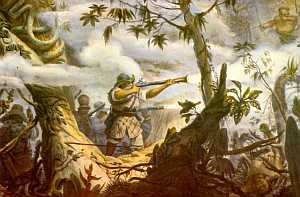
I wandered the sertão, the backlands, not just the wilderness beyond Bahia and in Amazonas but the sertão of the favelas of Recife and Rio de Janeiro. A literary bandeirante penetrating Brazil's past like those seventeenth century pathfinders, often feeling the thorny caatingas closing in on me but compelled to march forward like my hero, Amador Flores da Silva:
To Amador, to his father, to all who traveled with them, there would be no expression more evocative, more meaningful than sertão. 'Backlands;' 'wild country;' 'the unknown forest;' 'hill, valley, river hidden by the mist of Creation;' 'place of thorn and desert;''brutal land without end' - sertão was all these and more. It started not beyond the next rise or across the river ahead but deep within the soul, a call to paradise or to hell...
| The Bandeirante - Debret |
I kept a two hundred page journal on my four-month expedition across the length and breadth of Brazil. The scrawl on some pages vividly brings to mind a motorista, a bus driver, hanging on to the wheel as we sped through the caatingas. I remember triumphant cries of Asfalt! as we careened off a dirt road onto the hard-top. I remember glancing at a rear-view mirror and seeing a driver nodding off with half-closed eyes. I remember a girl in the seat next to me on her way to join a nunnery saying a prayer...
Some glimpses follow from a journey that lies at the heart of Brazil. I'd begun my research travels in Portugal where I stayed for three months in Sintra, the 'glorious Eden' of Lord Byron. I tried teaching myself Portuguese and learned enough to decipher the written word, more or less, but spoke the language poorly. I wrote to half a dozen people in Brazil in advance but essentially landed at Bahia, Salvador without a single contact... Journeying through Brazil in 1981, I traveled through the heart of a nation in which the flame of freedom was newly lit after years of military dictatorship, my journal colored by the voices and emotions of the era.
A Gringo in the White Forest of Brazil
Brazil - The Making of a Novel - Part 6
From Porto Seguro to Brasília, a tremendous leap in time and imagination that was to prove fateful. Though I did not know it then, I was being handed one of the keys to my vision of Brazil, the metaphor of Brasília and El Dorado. In his review of Brazil , the eminent Brazilian literary scholar, Professor Wilson Martins wrote:
What we have in front of us is the Brazilian national epic in all its decisive episodes — the indigenous civilization and the El Dorado myth that they themselves created and supported, passing it on to the hallucinated imaginations of the conqueror; the discovery and domination of the North-East; the Bandeiras and geographical expansion; the gold rush and nationalist feeling present, not only in the struggle against the Dutch but also the Inconfidência Mineira; the Royal Family's arrival and the Independence; the Second Reign and the war with Paraguay; the Abolition and the Republic — everything converging like the segments of a rose window in that reborn and metamorphosed myth that is Brasília, symbol of the proclaimed territorial integrity and, not without reason, with the expeditions that expanded to the south and to the west on the pretext of capturing Indians and searching for the “Golden Fleece.
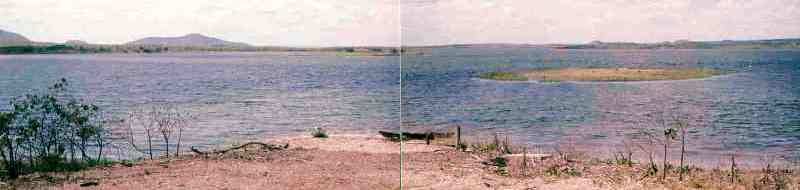
From Brasília, I traveled to Piauí and the sertão of Bahia, to Uauá and Canudos. Like so many other stops along my journey, I was there to brood over the past. I already had the broad picture but needed the innumerable small details to fill my canvas.
To have studied Euclides da Cunha's Rebellion in the Backlands and other sources was one thing, but go alone into the thorny caatingas ("White Forest",) walk for hours with the sun burning down on you, rest upon that stony earth, not a little fearful that you're totally lost — it takes little to imagine the hell that raged at Antônio Conselheiro's New Jerusalem.
| Site if Canudos, as it appeared after diversion of Vasa-Barris river. Locals believed it was intentionally flooded by government |
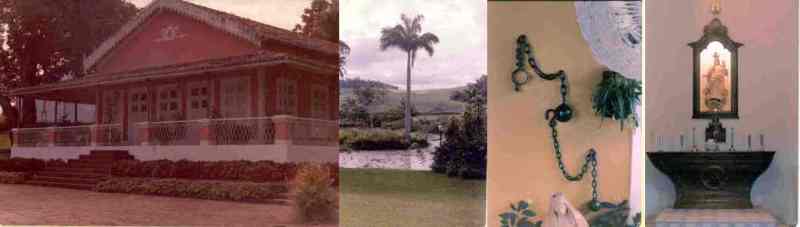
My next halt was at Recife and Olinda where I spent three weeks, mostly under the guidance of Gilberto Freyre's Joaquim Nabuco Foundation. With their help I found my valley of Santo Tomás and my imaginary town of Rosário, the locales for my fictitious family of Cavalcantis.
From Recife I traveled to Belém and embarked upon the Amazon, five days of brooding along the river sea to Manaus and on to Porto Velho. What I had in mind in journeying the wilderness was not so much Nature's glories but the men who were first to venture there: the bandeirantes. Nowhere but in those lonely tracts of forest could I get a sense of the enormity of their undertakings, their indefatigable spirit and courage.
From Porto Velho and Cuiabá, I headed south to Rio, São Paulo and Minas Gerais. After so many weeks it was a shock, traveling out of the backlands to the great cities. I was as bewildered and lonely as the sertanejo who goes south, but even as I felt this I knew my intuition to start my journey in the north had been right. Had I plunged into Rio or São Paulo at the start, I could've been drowned but up north I was able to absorb the Brazilian "thing" in small doses, day by day.
This is a very real problem in developing a book like mine, for in so short a time no outsider can possibly hope to get more than a superficial look at a great city like Rio de Janeiro. Which is why when I got down to writing Brazil I placed my two families beyond the cities, the Cavalcantis on Engenho Santo Tomás near Rosário and the da Silvas of bandeirante ancestry at the fictional Itatinga on the Rio Tietê, their worlds a microcosm of the greater Brazil beyond.
| Glimpses of the Casa Grande, Pernambuco, Brazil |
Inside Brazil - Take A Magical Journey Beyond The Clichés and Stereotypes
"A masterpiece! Brazil has the look and feel of an enchanted virgin forest, a totally new and original world for the reader-explorer to discover. -- L'Express, Paris
Brazil is a spellbinding saga of two powerful families that depicts five turbulent centuries in the history of a remarkable land. From colony to kingdom, from empire to nation, Brazil is filled with memorable people living through one of the great adventures in human history.
When writer Errol Lincoln Uys sat down to tell the story of Brazil, he had a key objective in mind: Avoid the stereotypical images of Brazil and its people.
"I rejoice in Carnival, samba, soccer," says Boston-based Uys (pronounced 'Ace'). "Like so many gringos, I knew little else about Brazil. In writing my novel, I discovered one of the great adventures in human history -- the story of an extraordinary people who built the dynamic nation we see today."
Two powerful families drive the story alongside an awesome array of characters, fictional and real. The Cavalcantis are among the original settlers and establish the classic Brazilian plantation -- vast, powerful, built with slave labor. The da Silvas represent the second element in both contemporary and historical Brazil: pathfinders and prospectors. For generations, these adventurers have set their eyes on El Dorado, which they ultimately find in a coffee fortune at Sāo Paulo.
Brazil is an intensely human story, brutal and violent, tender and passionate. Perilous explorations through the Brazilian wilderness . . . the perpetual clash of pioneer and native, visionary and fortune hunter, master and slave, zealot and exploiter . . . the thunder of war on land and sea as European powers and South American nations pursue their territorial conquests... the triumphs and tragedies of a people who built a nation covering half the South American continent, all are here in one spell-binding saga.
Just how successful Errol Lincoln Uys is in capturing the Brazilian epic is best judged by what Brazilian reviewers and readers say about Uys’s 800-page masterpiece devoted to their country.
“Brazil is a classic which will be enjoyed by many in the years to come.” — Agenor Soares dos Santos
“Brazil is a country of enormous contrasts and you had great insight in reflecting such differences in your book through the lives of two fictional families, one from the north and one from the south. When I read your book those feelings I had about the contrasting reality we face daily in Brazil were translated into words. I felt that a puzzle was finally put into place. I hope that writing this book has given you as much pleasure as I had in reading it. “ — Maria Pereira de Queiroz Brandão Teixeira
“Your book gave me a completely new way of viewing Brazilian and Portuguese history. Suddenly everything seemed clear: The raw truthfulness that was the reality of those times and which never comes across so clearly or vividly in history books. Truly, Brazil is a masterpiece!” – Vasco Cartó
“A beautiful work! It took more than a month to read your book, but I enjoyed every moment. It's one of the most solid researches I've seen covering five centuries of Brazil's multi-faceted history. The story line is gripping, easy to understand. My sincere congratulations. “ — Professor Max Justo Guedes
“Brazil is a monumental novel. It shows the juxtaposition of sensual/brutal Brazil...It is amazingly on target not only in the historical sense but insightful for the complex modern Brazil, principally the all-important extended family. A theme vividly illustrated in the first chapters and carried throughout the novel.” — Edson Nery da Fonseca
“I am Brazilian but have lived in the United States since the age of two. After reading your novel, I feel I can regain the culture that I lost — I feel more Brazilian! I don't believe I would ever have felt this strongly about my people if I hadn't read your book.” — Moises A. dos Santos
Says Wilson Martins, one of Brazil’s most eminent literary critics: “Errol Lincoln Uys is the first to write our national epic in all its decisive episodes – the first outsider to see Brazil with total honesty and sympathy. Descriptions like those of the war with Paraguay are unsurpassed in our literature and evoke the grand passages of War and Peace.”
"A masterpiece! Brazil has the look and feel of an enchanted virgin forest, a totally new and original world for the reader-explorer to discover. -- L'Express, Paris
"Pulsing with vigor, this is a vast novel to tell the story of a vast country. Uys depicts Brazil's evolution from colony to empire to republic. Lacing the tale together are two families: the Cavalcantis, planters and slave owners; and representing another fundamental social stream, the da Silvas, prospectors, adventurers, seekers of El Dorado." Publishers Weekly
"No one before knew how to bring to life Brazil and her history. Uys's characters are brilliant and colorful, combining elements of the best swashbuckler with those worthy of deepest reflection. Most stunning is that it took a South African, now a naturalized American, to evoke so perfectly the grand but interrupted dream that is Brazil." -- Le Figaro, Paris
What better way for the reader-explorer of an epic as vast as Brazil to discover a totally new and original world! A great summer read!
FREE ONLINE EXTRAS
AN ILLUSTRATED GUIDE TO BRAZIL, THE NOVEL – WITH 300 IMAGES AND MAPS
AUTHOR’S JOURNAL FROM A FOUR-MONTH, 15,000-MILE TREK FROM THE AMAZON JUNGLE TO THE SOUTH OF BRAZIL
THE MAKING OF A NOVEL, WRITER’S GUIDE TO THE AUTHOR’S FIVE-YEAR QUEST FOR BRAZIL

Subscribe to:
Comments (Atom)