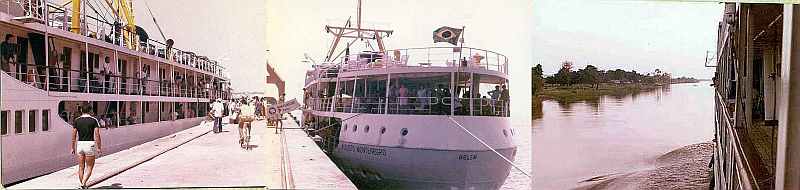
The Journey - Amazon River, August 23, 1980
As the canoe moves along, only occasional flash of brilliant color. I think most of the birds have retreated deeper into the forest, as with the monkeys and other wild life, what little there is. I'm surprised by a lack of color other than green, only occasional touch of mauve, yellow or white, but put this down to dry season. During five days, several tropical downpours, short, furious, bursts of rain mainly in the afternoon, a respite from the heat.
Humble houses, pathetic little escolas alongside the tributaries, seem to attest to the impotence of man in this mighty environment. One is aware of the great wounds left in the forest by vast projects: as EMBRAPA pointed out, left to itself the forest can regenerate secondary growth in three to five years. This is not to say there isn't a threat.
The “Hollywood” version of the Amazon jungle is more impressionistic than  real. I think many Amazon “adventures” were shot in California backlots showing a density and height that's not right. The greatness of the Amazon lies in its horizontal and not vertical spread; its sheer size and variety is what gives it an awesome aspect. Under the canopy, you can let your imagination drift back to the very beginnings of earth.
If man is out of scale, so are the river fish. Saw a pirarucu that had been harpooned, six to seven feet, like a porpoise with “chain-mail” scale protection, so hard they're used as nail files.
The lianas look like taut cables stretching skyward, sometimes perfectly straight. Walking within forest, immediately assaulted by countless insects. Leaned against a tree and found small maggot-like creatures with pint-point black heads on arm. Think they're chiggers that bore into your skin. Repulsive to “civilized” man.
Walking along shore to swamp, water-logged trees, undergrowth... Picture how it must have been for those like the Madeira-Mamoré railroad workers wading through stench, insects, slimy mud underfoot, near  impossibility once you enter area to find clean water.
Manaus, itself, continues to be an enigma, this island-city with its skyscrapers rising suddenly beyond the final hill as you emerge from the forest. The older, almost bizarre-looking architecture, English and French structures, market-place, library, post office, opera house take prize for incongruity. Though surely gave Manaus a special atmosphere during rubber boom days, unique and totally unlike skyscraper skyline of today.
Today's newspaper carried sobering news that Glauber Rocha died, age 43, of heart attack in Rio. (We lived as neighbors in Sintra, Portugal, prior to my coming to Brazil.) Was talking about Rocha last night at film of Getúlio Vargas.
(Some impressions from Vargas film: Depicted era similar to Peron/Bittencourt. First, there was striving for a Brazil independent of foreign dependency, multinational “colonialism.” 2) Genuine attempt to improve “lot of the workers.” Enormous popularism. 3) Many, many military-style parades in late 30s vaguely reminiscent of Mussolini's Italy, youth brigades etc. 4) symbolic flag burning, representing end of state hegemony and move toward national unity 5) Vargas, small, chubby, round-faced, spectacles, often smiling, seemed a genuine honest type. (Whatever the bias of film, I found it incredible to accept his suicide. Suicide note was a forgery to cover up his murder? I wonder. Must put that to sources.)

Almost time to go to the “Rodoviária” again — a word I will never forget. Twenty-one hours to Porto Velho.