Showing posts with label Antônio Conselheiro. Show all posts

Canudos: Visions of a Hill where God's Thunderer Roared

 
Brazil - The Making of a Novel - Part 15
 
The Journey:  Uauá and Canudos, July 25 — July 27, 1980
 
 
Arrive at Uauá to find contact arranged via Antonietta out of town for a week but within minutes his wife arranges for a family friend to take me to Canudos tomorrow.
 
Amusing introduction to Uauá in Hotel Gonçalves run by a mother and her five daughters. As word spreads, I find myself seated at table with twelve women of the town come to observe estrangeiro.
 
Hotel floor is divided into cubicle-like rooms with walls open at the top, the occupant of the room next to me snoring away happily all night.
 
July 25 - July 27. Two and a half days with no journal entry, through lack of time and place. Earlier efforts on bus inadequate/difficult and besides, observations in the sertão grow predictably similar. Which, in a way, is the point about the sertão: vast, repetitive, soulless backlands, mile upon mile of caatingas, close-packed, mind encroaching. Step into it a few meters from the side of the road and you are lost. It enfolds and absorbs you. 
 
                                           
A brief visit to Canudos on Sunday provided as much as I wanted from the "present." There's a danger of getting put off track by too much modernism. I have strong impressions and ideas about Canudos/Antônio Conselheiro and my mind relates them to the 19th century. — What I behold in the 20th is a distraction and can only water down those impressions developed from reading and thinking. Preconceptions, if you will.
 
Curious aspect of Sunday was “Manoel” from Mozambique and left after independence. Within minutes of meeting him, he begged me not to mention “Moz” because, hand on heart, “it was too much for him,” and “all because of Samora Machel.” Manoel sells jewelry in the Brazilian sertão after “Moz” and Rhodesia (Zimbabwe,) where he was a linotype operator.
 
I don't know how many Manoels there are in this country but cannot see them doing anything to improve race relations Brazilian style. Though first he wanted to avoid the subject, Manoel had more and more to say as the day progressed. Stories like the man who disowned his mother because she wrote from Portugal saying that he should come back to the motherland, but “bring nothing that you took from the blacks.” According to Manoel, the man wrote back to Senhora X saying from that time he did not consider her his mother. Manoel personally does not wish to tread the soil of Portugal because of the “traitors.”
 
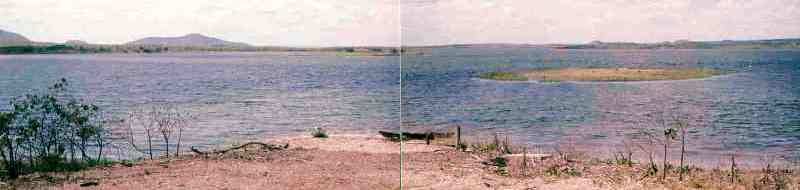
Even as I traveled toward Canudos I had visions of this barren, wasted sertão where a mystic's most fervent ramblings could take easy root. Interpretations of Glauber Rocha aside, the site of Canudos today lies beneath a barrage! A placid backwater with a small island where a few goats and sheep are rowed across to graze.
 
Canudos Brazil barrage
 
Locals suggest that the flooding of the valley was a political move, but I'm skeptical. It was, so far as I know, commenced in 1953. At that time, the kind of political consciousness/reappraisal/revisionist tendency we have today was in its infancy. Few outsiders would have taken symbol of Canudos seriously.
 
Nothing, absolutely nothing, to suggest that 20,000 people died in this small valley, nothing to bring back the echo of the small cannon from a nearby hill or roar of "God's Thunderer" from the larger hill beyond....
Canudos refugees, 1897
Anyway, I got what I wanted, a soul-filling understanding of the terrain, of the small towns of the time, of the people. Was surprised by Mrs. Gonçalves (of hotel) reciting word for word a prayer said by an old man who'd survived Canudos. Though few beyond the area remember it, Canudos is very much part of local folklore...

A Gringo in the White Forest of Brazil

Brazil - The Making of a Novel - Part 6
 
From Porto Seguro to Brasília, a tremendous leap in time and imagination that was to prove fateful. Though I did not know it then, I was being handed one of the keys to my vision of Brazil, the metaphor of Brasília and El Dorado. In his review of Brazil , the eminent Brazilian literary scholar, Professor Wilson Martins wrote:   
 
What we have in front of us is the Brazilian national epic in all its decisive episodes — the indigenous civilization and the El Dorado myth that they themselves created and supported, passing it on to the hallucinated imaginations of the conqueror; the discovery and domination of the North-East; the Bandeiras and geographical expansion; the gold rush and nationalist feeling present, not only in the struggle against the Dutch but also the Inconfidência Mineira; the Royal Family's arrival and the Independence; the Second Reign and the war with Paraguay; the Abolition and the Republic — everything converging like the segments of a rose window in that reborn and metamorphosed myth that is Brasília, symbol of the proclaimed territorial integrity and, not without reason, with the expeditions that expanded to the south and to the west on the pretext of capturing Indians and searching for the “Golden Fleece.
 
From Brasília, I traveled to Piauí and the sertão of Bahia, to Uauá and Canudos. Like so many other stops along my journey, I was there to brood over the past. I already had the broad picture but needed the innumerable small details to fill my canvas.
 
To have studied Euclides da Cunha's Rebellion in the Backlands and other sources was one thing, but go alone into the thorny caatingas ("White Forest",) walk for hours with the sun burning down on you, rest upon that stony earth, not a little fearful that you're totally lost — it takes little to imagine the hell that raged at Antônio Conselheiro's New Jerusalem.
 
Site if Canudos, as it appeared after diversion of Vasa-Barris river.
Locals believed it was intentionally flooded by government
 
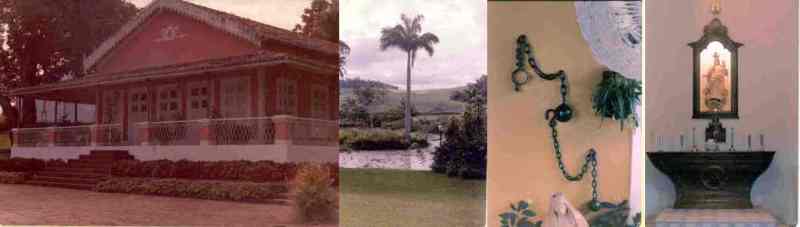
My next halt was at Recife and Olinda where I spent three weeks, mostly under the guidance of Gilberto Freyre's Joaquim Nabuco Foundation. With their help I found my valley of Santo Tomás and my imaginary town of Rosário, the locales for my fictitious family of Cavalcantis.
 
From Recife I traveled to Belém and embarked upon the Amazon, five days of brooding along the river sea to Manaus and on to Porto Velho. What I had in mind in journeying the wilderness was not so much Nature's glories but the men who were first to venture there: the bandeirantes. Nowhere but in those lonely tracts of forest could I get a sense of the enormity of their undertakings, their indefatigable spirit and courage.
 
From Porto Velho and Cuiabá, I headed south to Rio, São Paulo and Minas Gerais. After so many weeks it was a shock, traveling out of the backlands to the great cities. I was as bewildered and lonely as the sertanejo who goes south, but even as I felt this I knew my intuition to start my journey in the north had been right. Had I plunged into Rio or São Paulo at the start, I could've been drowned but up north I was able to absorb the Brazilian "thing" in small doses, day by day.
 
This is a very real problem in developing a book like mine, for in so short a time no outsider can possibly hope to get more than a superficial look at a great city like Rio de Janeiro. Which is why when I got down to writing Brazil I placed my two families beyond the cities, the Cavalcantis on Engenho Santo Tomás near Rosário and the da Silvas of bandeirante ancestry at the fictional Itatinga on the Rio Tietê, their worlds a microcosm of the greater Brazil beyond.
 
Glimpses of the Casa Grande, Pernambuco, Brazil