Showing posts with label Brazilian culture. Show all posts

Brazil - A history in pictures


An online guide with a wealth of photos and illustrations giving a unique insight into the history of Brazil.

Links to the Illustrated Guide to Brazil can be found at the end of each section of the digital edition of the epic of Brazil enhancing the reader's enjoyment of a spellbinding saga "with the look and feel of an enchanted virgin forest, a totally new and original world for the reader-explorer to discover."

Brazil is the first work of fiction to depict five centuries of a great nation's remarkable history. With a stunning cast of real and fictional characters, this unforgettable epic unfolds in South America, Africa and Europe.


Brazil has a large cast of characters. The Cavalcantis of Santo Tomás and the da Silvas of Itatinga and most of the incidents involving these families are fictional. Aruanã, Secundus Proot, Black Peter, the Ferreiras, Patient Anthony, Armand Beauchamp, Henrique Inglez, Bábá Epifánia – these, too, are imaginary characters. 

King Afonso I of the Kongo; Nóbrega and Anchieta; Tomé de Sousa; Mem de Sá; Raposo Tavares; Johan Maurits; “Ganga Zumba;” Pombal; Tiradentes; Pedro II; Francisco Solano López; Eliza Alicia Lynch; Joaquim Nabuco; Anthony, the Counselor; Juscelino Kubitschek; Vilas Boas; Herbert “Betinho” de Sousa – these are real characters and what is said of them relates to recorded history.


Brazil - The epic of a great nation

Reflections on Slavery and Servitude in Brazil

Brazil - The Making of a Novel - Part 26
  

The Journey -  Amazon River,  Augusto Montenegro, Belém to Manaus, August 12 - August 17, 1980

August 15- August 16: At one point last night, some of us commented on behavior and service of crew in what is obviously one of the great attractions of Brazil. They're surly, uncooperative, unprofessional, ungrateful. They give the impression of simply not caring, one way or the other. Reflecting on this, a Brazilian at the table said that the difference between them and, say people in the service industry in Europe/U.S. was that here they were an extension of the servitude of slavery.
 
Interesting point, especially when considered against fact that slavery was only abolished in 1889, less than a hundred years ago. Just as there are many misconceptions or ignorance about the finer aspects of Brazilian history, so, too, the darker side. Brazilians pride themselves on the peaceful, humane liberation of their slaves but I'm beginning to believe that the truth may run somewhat contrary, that they have an exceptionally long way to go to finalize the adjustment between slavery/freedom. “Born free to live in chains,” truly applicable!
 

Brazilian Slave Ship - Johan Moritz Rugendas
New York Public Library Digital Collection
Elsa, the German girl stayed with a casa grande family in Fortaleza and was convinced there is also a racial element: Her hosts kept reminding her that they were “Portuguese,” i.e. “white” of the best sort. The dona of the house boasted that she had already “sold” six servant girls to the south. Elsa took that literally, though I suspect it's more of the South African way of “selling” — the arranging of girls from the farm “good girls” to go south where they're coveted because they're “honest, reliable,” that sort of thing.
 
Another subject that came up was the “internationalization” of the Amazon basin, once suggested by a U.N. conference but, predictably, violently resisted by the Brazilians. (In the north, among few expressions of political graffiti: AMAZONIA PARA BRASILEIRO.) A young Brazilian passenger himself suggested that this would be only way to “develop” the area properly. From what I have seen and heard about other “development” projects in the North-North-East, I'm inclined toward agreeing. At the same time, I have to consider the effect of the Tropics on Western Man - Perhaps Gilberto Freyre is too optimistic, idealistic - Perhaps the true Brazilian, man of the tropics, has not yet appeared on the scene or developed sufficiently to cope with the land, the climate and its challenges.

Amazon River settlement near Manaus
 
Spending time with the two Brits, unfortunately, brings my Brit-background prejudices to the surface and I have constantly to remind myself that this is Brazil and Brazilians are different. Nevertheless, I do find several things disgusting. The spitting. A downright unhealthy habit. At least on the ship the aim is over the side! Also on hygiene, lavatories are often stinking, blocked affairs with horrid little wastepaper baskets for toilet paper, open and exposed.
 
Then, too, the food: With rare exception, usually in private homes, it's the same monotonous starchy stuff, steak, chicken, potatoes sometimes, rice, farina, beans. The food markets in the Amazon ports are the worst I've seen anywhere. Great, open mounds of freshly-butchered meat, minimal vegetables and little to see of the exotic tropical fruits people rave about. An inveterate traveler, I can stomach a great deal but here even I reach a limit.
 
Where do you begin to build a “modern nation”? Aren't these basic lifestyles important? Cleanliness next to godliness, says the proverb?
 
I wonder, though, just how much the negative thoughts expressed here are a reflection of the depressed North-East and the unfathomable “green hell.” How heavily do those weigh on a man's soul? What will the contrast be like in the south?
 
Also discussed the difficulty of bridging the gap between “moneyed (apparently) estrangeiros” and locals aboard prompted by so small an incident as attitude of barman. One senses his resentment of foreigners' continual ability to go up and buy beers, cool drinks etc...It would be almost impossible to explain to him that every cent of this was worked for year after year. Says the young Brazilian with us: “They think like slaves.” Or is it simply, a “tropical” don't-give-a-damn mentality. 
Amazon Voyage  1980


BRAZIL - The Epic of a Great Nation


Brazilian Adventure - A Call to Paradise or to Hell

Brazil - The Making of a Novel - Part 8
 
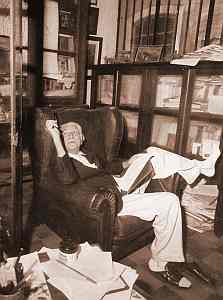
The famed Brazilian sociologist, Gilberto Freyre, asked me whether I based my story of generations of Cavalcantis on the secret unpublished journal of a Brazilian family. There were times during my five year odyssey on Brazil when I surely wished I possessed such a private diary. - There was no diary only the will to understand the Brazilian “thing.”
 
Professor Gilberto Freyre
Part of that understanding came from the journey I took over four months in 1981 traveling 20,000 kilometers through Brazil, almost entirely by bus. I visited the Casa Grandes; the big fazendas; the splendid beachfront apartments; the glass and concrete wonder of Brasília - the new El Dorado! I walked the sands of Porto Seguro; I rejoiced in the atmosphere of the Bahia; I stood in silence between sepulchral hills at Canudos. I climbed another hill, too, to gaze down on Vila Rica do Ouro Preto and imagine the handicapped sculptor Aleijadinho moving along Vila Rica's cobbled streets. I heard the muffled drum of tyranny presaging the last act in the drama of Tiradentes, martyr of Brazilian independence.
 
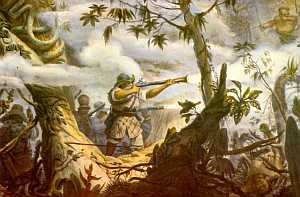
I wandered the sertão, the backlands, not just the wilderness beyond Bahia and in Amazonas but the sertão of the favelas of Recife and Rio de Janeiro. A literary bandeirante penetrating Brazil's past like those seventeenth century pathfinders, often feeling the thorny caatingas closing in on me but compelled to march forward like my hero, Amador Flores da Silva:
                               
To Amador, to his father, to all who traveled with them, there would be no expression more evocative, more meaningful than sertão. 'Backlands;' 'wild country;' 'the unknown forest;' 'hill, valley, river hidden by the mist of Creation;' 'place of thorn and desert;''brutal land without end' - sertão was all these and more. It started not beyond the next rise or across the river ahead but deep within the soul, a call to paradise or to hell...

The Bandeirante - Debret
 I kept a two hundred page journal on my four-month expedition across the length and breadth of Brazil. The scrawl on some pages vividly brings to mind a motorista, a bus driver, hanging on to the wheel as we sped through the caatingas. I remember triumphant cries of Asfalt! as we careened off a dirt road onto the hard-top. I remember glancing at a rear-view mirror and seeing a driver nodding off with half-closed eyes. I remember a girl in the seat next to me on her way to join a nunnery saying a prayer...               
 
Some glimpses follow from a journey that lies at the heart of Brazil. I'd begun my research travels in Portugal where I stayed for three months in Sintra, the 'glorious Eden' of Lord Byron. I tried teaching myself Portuguese and learned enough to decipher the written word, more or less, but spoke the language poorly. I wrote to half a dozen people in Brazil in advance but essentially landed at Bahia, Salvador without a single contact... Journeying through Brazil in 1981, I traveled through the heart of a nation in which the flame of freedom was newly lit after years of military dictatorship, my journal colored by the voices and emotions of the era.