A Day at Modelo Mercado; A Night with "Decadent Aristocrats."

Brazil - The Making of a Novel - Part 11

The Journey: Salvador, Bahia  July 8 - July 11
 
Grab a few hours this a.m. for “office work.” Must allow more time for mental appraisal/assimilation of the barrage of information. Feel pretty secure with picture of Bahia for Tomás's arrival, Padre Inácio etc. (These are characters from my Outline for Brazil written earlier and based on book knowledge of Brazil and research in Portugal.)
 
Went to Antonietta's house in Sapateiros. Drunk, soiled beggar in doorway. We spent three hours poring over books from her four-thousand volume library. Especially impressed with her bandeirante material. Rest largely comprises works on churches, churches, churches. “Nossa Senhora” (Our Lady) are two words I'll never forget
 
In afternoon we go to the market, Mercado Modelo. An explosion of life Bahianese! Essentially a tourist/handicraft market, it has a restaurant attached to it. A vast meeting place where beer flows like water and people sing the songs of Bahia. For three hours, we eat and listen to the Afro-Brazilian rhythms. Again bringing a thought of the “release” from the slave quarters. (My South African heritage shames me in this blackest of all Bahiana cities!)
 
Historic Salvador, Bahia
with Mercado Modelo  Photo: Fernando Molina/Wikipedia

Back to Antonietta's house in the oldest quarter and for four-and-a-half hours she sits reading my synopsis. Her verdict is ENTHUSIASTIC! And a good deal more! Few Brazilians know the history as ELU, she says. Encouraging.
 
For an hour afterwards, we sit talking about the political realities, '64 to present. Troubling. She explains background of the opposition PF (Popular Front) to which she belonged aimed at grassroots change, alongside PCdoB(Communist Party, Maoist) and PCB (old Prestes group, pro-Soviet.) Also active were Focustas (from “focus”) who became most radical element. After congress, PF merged with PCdoB to work for reforms.
 
Pro Democracy Demonstration in Brazil 1984
Photo: Jorge Henrique Singh via Wikipeida

She talks of strong-arm methods/disappearance of friends etc. All very similar in most respects to South African situation.
 
Not clear of objectives, though main purpose “to improve condition” of the people. That's too broad for my liking. In recent times, things appear to have eased up but not clear to what extent. She stresses role of the Church. Even though it may not be evident in outward ways, e.g. church attendance, the Catholic spirit is fundamental to Brazilians.
 
Antonietta refers to 1 percent of population being truly “educated,” traveled etc. including those like herself whom she describes as “decadent aristocrats.”
 
Our talks end at 1.40 A.M. I've decided to move to Porto Seguro on Monday morning; Brasília next Thursday.

The Sound of the Bells and the Crack of the Whip in old Salvador

Brazil - The Making of a Novel - Part 10

The Journey: Salvador, Bahia  July 8 - July 11

July 8 I'm determined to keep this journal daily so though it's late, after a delightfully exhausting six hours with the best contact I've made in three months, I'll scribble a few lines.
 
Prayerful as I was last night, today started at 9 a.m. at Henriques' office. 9.10: “There is a problem.” - “Urgently called to accompany the director to a distant town to discuss plans for centenary etc.” - “Please come to Sally's office and we will find somebody.” Temper rising but nothing I can do about it!! Patience. Sally makes phone call to "Antonietta" at the Archives. She can meet me at the Cathedral at 4.30. (Today, all Bahia life grinds to a halt because of Brazil vs. Spain soccer game.)
 

Salvador Brazil Cathedral
Cathedral at Salvador, Bahia
Kill time noon to 4.30 including bumping into exuberant Germans who were in taxi with me Tuesday a.m. They've “seen it all” - three hour tour and night of folklore and are leaving for Rio at 2.30! At 4.30 find  Antonietta (de Aguiar Nunes) waiting in the doorway of the Cathedral. Go through my routine "introduction" again but this time find a perfect gem. A history professor mastering in social work, Antonietta “knows it all,” genuinely.
 
Plunge into a three conversation, then to dinner at Pelourinho Square (restored by UNESCO) at "hotel school" that offers forty kinds of Bahia cuisine = African modified by spices of East (as per fleets from India.) Tomorrow we're to meet at nine to continue the “researches.” The Good Lord be praised! Despite the Henry hitch, all augers well for the Brazilian adventure.
 
July 9 — A brilliant day! Won't attempt to repeat what's in my working notebooks. (Besides my journal, I filled a pile of notebooks as I went along.) Antonietta's contacts are stupendous, her enthusiasm unlimited. Now to bed, for I'm exhausted but in these early days of the journal, determined to make some entry, no matter how insignificant.
 
July 10-11 — Missed two nights' entries. Not through “sloth” but time! July 10 occupied with “re-creation” of 18th century Bahia. How the Portuguese must've loved this city! With its narrow, hilly cobbled streets, it is strong reminiscent of Lisbon and Coimbra. Most impressive is the Pelourinho - Pillory Square - with the old townhouses of the wealthy. The Pillory was moved here at the request of the Jesuits - it had previously been near the Cathedral - the lash and the bell/choir aren't compatible.
 
Salvador Brazil
Salvador, Bahia, Brasil
 
I am slowly conditioning myself to life as lived here. On Thursday evening Professor Antonietta and I are invited to plantation 70 kilometers north with loan of car. On Friday evening the invite falls through. "A's" sister has arrived. "A" needs car and so on. Change plans. I wander streets by myself.
 
Among many sights is a carpenter's shop. Men at lunch round table surrounded by wood shavings, playing dominoes etc. One-eyed carpenter. Easily 18th century!
 
In evening we go to sound and light show at 17/18th century seafront fazenda that includes tobacco warehouse/slave quarters. Can't follow libretto and am somewhat irritated by excessive use of colored lights but get the ambiance.
 
Nothing impresses so much as the voices of the prayerful from the small chapel rising alongside crack of a whip wielded against the slaves. Can see why the Jesuits asked that this scourge be moved from their holy place.
 
Earlier in the day visited convent with foundling wheel — larger than I expected — Some said it was an excuse for the nun's own progeny. Convent built by a wealthy man with five daughters. All the girls consigned to the building for life. Nice pater!

Landing in Salvador - Princess Paraguaçu, Two Abandonados, a Cockroach and a Prayer

Brazil - The Making of a Novel - Part 9
 
The Journey; Salvador, Bahia, July 7 - July 14
 
(Landed at 3.40 a.m.) Early morning arrivals are disastrous, especially when coupled with congress of six thousand medicos starting tomorrow. Good-intentioned cab driver drops me at sea front. Gray sky, showers, pre-dawn humidity. First hotel full, second $50 a night. Find myself walking back toward Centro after stop for Coke at kiosk where my “jacket Americano” is main interest. Also my $1 note for Coke. Scrawny woman creeping in and out of shadows to beg a cigaretta.
 
Finally made it via VW taxi to “Hotel Imperial” in Centro at 6.15 and get room at 900 cruzeiros (91cr. to $1.) A benign fleapit. Shocking pink walls. Cockroach at eye level when I wake five hours later. Noise. Deadly shower system (loose electric wires dangling from heating unit) but probably a lot better than what lies ahead and able to keep me within my $30-a-day budget. (And, as usual, contradicting LdJ's observations on “horribly expensive Brazil.”) I had perfectly adequate dinner of chicken, feijoas, rice, salad, beer and tip for 330cr. ($3.50)
 
Salvador Brazil harborFirst impressions of Salvador come from the large black population. Were this not Brazil, you could expect to awake in a West African seafront town.
 
First encounter with abandonados particularly memorable in visage of two little girls who'd steal many a U.S. heart. Sad if one considers all the implications beyond the empty soda tin thrust toward you but yet not pathetic.
 
There was a liveliness, a vivacity, as in their response when a customer at the snack bar ordered a glass of water which he tossed over them! In contrast, a young boy who was approached stopped to talk with the prettiest of the two girls, gave her a fond clasp on her shoulder - no money - before going on his way.
 
The urgency of getting down to serious work after the Portuguese experience impresses upon me. By 4.30 I've spent two and half hours with the Bahia information people who seem much more on the ball. Arrange to spend day with Henriques Caldeira. I'm impressed with the “sense of history” shown by these first contacts: Dona Linda Conde, who spoke of a plantation that's been in her family for 250 years; Henry who is Jewish and traces his ancestry back to the Dutch/Portuguese connection and Dona Gildene who is a great-great-great + granddaughter of Paraguaçu, the Indian princess who married Caramuru. Dona Gildene also has Dutch ancestry. (Must check influence of Dutch influence down here.)
 
This first brief foray suggests Bahia is font of Brazilian culture. Am also beginning to realize importance of maintaining this journal to remember all that comes at me and to have this “self-communication” each evening. This self-imposed silence for one so garrulous as me is unusual!
 
I go to bed quietly hopeful and prayerful. Have, as I did in Portugal with the likes of Serrão, prepared a list of “interests.” Pray God that they come up to expectations. I close Day One with a sense of cautious optimism.
 
Princess Paraguaçu and Caramuru


The Epic of Brazil on Amazon Kindle


“Through the lives of two powerful families, Brazil depicts five turbulent centuries in the history of a remarkable land. From colony to kingdom, from empire to nation, Brazil is filled with memorable people living through one of the great adventures in human history.”

A masterpiece! Brazil has the feel of an  enchanted virgin forest, a totally new and original world for the reader-explorer to discover.  L' Express, Paris

Pulsing with vigor, this is a vast novel to tell the story of a vast country. Uys recreates history almost entirely "at ground level," through the eyes and actions of an awesome cast of characters.  Publishers Weekly

Uys has accomplished what no Brazilian author from José de Alencar to Jorge Amado was able to do. He is the first outsider with the total honesty and sympathy to write our national epic in all its decisive episodes. Descriptions like those of the war with Paraguay are unsurpassed in our literature and evoke the great passages of War and Peace Wilson Martins, Jornal do Brasil

The Kindle edition comes with a free Illustrated Guide to the Novel.
 

Brazilian Adventure - A Call to Paradise or to Hell

Brazil - The Making of a Novel - Part 8
 
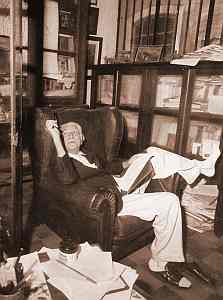
The famed Brazilian sociologist, Gilberto Freyre, asked me whether I based my story of generations of Cavalcantis on the secret unpublished journal of a Brazilian family. There were times during my five year odyssey on Brazil when I surely wished I possessed such a private diary. - There was no diary only the will to understand the Brazilian “thing.”
 
Professor Gilberto Freyre
Part of that understanding came from the journey I took over four months in 1981 traveling 20,000 kilometers through Brazil, almost entirely by bus. I visited the Casa Grandes; the big fazendas; the splendid beachfront apartments; the glass and concrete wonder of Brasília - the new El Dorado! I walked the sands of Porto Seguro; I rejoiced in the atmosphere of the Bahia; I stood in silence between sepulchral hills at Canudos. I climbed another hill, too, to gaze down on Vila Rica do Ouro Preto and imagine the handicapped sculptor Aleijadinho moving along Vila Rica's cobbled streets. I heard the muffled drum of tyranny presaging the last act in the drama of Tiradentes, martyr of Brazilian independence.
 
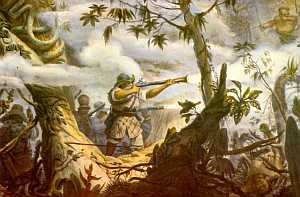
I wandered the sertão, the backlands, not just the wilderness beyond Bahia and in Amazonas but the sertão of the favelas of Recife and Rio de Janeiro. A literary bandeirante penetrating Brazil's past like those seventeenth century pathfinders, often feeling the thorny caatingas closing in on me but compelled to march forward like my hero, Amador Flores da Silva:
                               
To Amador, to his father, to all who traveled with them, there would be no expression more evocative, more meaningful than sertão. 'Backlands;' 'wild country;' 'the unknown forest;' 'hill, valley, river hidden by the mist of Creation;' 'place of thorn and desert;''brutal land without end' - sertão was all these and more. It started not beyond the next rise or across the river ahead but deep within the soul, a call to paradise or to hell...

The Bandeirante - Debret
 I kept a two hundred page journal on my four-month expedition across the length and breadth of Brazil. The scrawl on some pages vividly brings to mind a motorista, a bus driver, hanging on to the wheel as we sped through the caatingas. I remember triumphant cries of Asfalt! as we careened off a dirt road onto the hard-top. I remember glancing at a rear-view mirror and seeing a driver nodding off with half-closed eyes. I remember a girl in the seat next to me on her way to join a nunnery saying a prayer...               
 
Some glimpses follow from a journey that lies at the heart of Brazil. I'd begun my research travels in Portugal where I stayed for three months in Sintra, the 'glorious Eden' of Lord Byron. I tried teaching myself Portuguese and learned enough to decipher the written word, more or less, but spoke the language poorly. I wrote to half a dozen people in Brazil in advance but essentially landed at Bahia, Salvador without a single contact... Journeying through Brazil in 1981, I traveled through the heart of a nation in which the flame of freedom was newly lit after years of military dictatorship, my journal colored by the voices and emotions of the era.

The Woman with One Orange in Brasília

Brazil - The Making of a Novel - Part 7

More than the land, the Brazilian people themselves gave me the thousand and one insights I needed. Try to imagine a stranger coming to you and telling you he is going to write a novel about the entire history of Brazil. Five hundred years! A crackpot! Louco!
 
Bemused some were but with one solitary exception, a fiery young man of Manaus who flew into a rage and said an estrangeiro had no right to "steal Brazil's past,” save for this lone objector, I'd unstinting help and support from hundreds of people, some giving me days of their time, some only precious moments. An unnamed peasant woman standing next to me in a bus queue in Brasília and asking that I buy an orange for her sick child: I realized later that the orange was all the pair had for nourishment on a twenty-six hour bus trip.
 
I kept my daily journal during my trip and filled twenty notebooks. I pored over dozens of maps, paintings, photographs, absorbing and interpreting this mass of information as I went along. I was not bound by the same constraints as the historian, my book is a work of the imagination, but I was under an obligation to get the facts right. Foremost was an overriding desire to write a book that was accurate, balanced and avoided stereotypical images and over-simplifications that often mar the works of outsiders attempting popular fiction about Latin America.
 
Where my interpretations revise commonly-held views, I arrived at my conclusions only after the most critical thought.
 
My view of Brazilian slavery, for example, particularly the early centuries is harsher than what was usually portrayed.
 
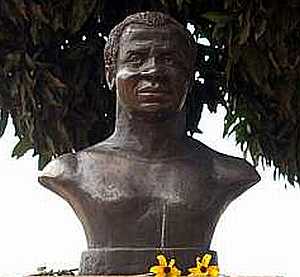
I did not study Brazilian slavery in isolation but looked at the Portuguese record in Mozambique and Angola, particularly the degradation of the Congo; the more I thought about it, the less I believed that the harsh Portuguese slaver in Africa could miraculously be transformed into a paragon in Santa Cruz. Palmares was the quilombo that made "headlines,” but how many others were there? Tens of thousands of runaway slaves do not suggest a benign regime of bondage.
 
"Ganga Zumba" of Palmares
             
I asked myself time and again, and not only with slavery: through whose eyes was the past beheld? Almost never in a colonial situation does one find anything but the official story neatly penned for bureaucrats thousands of miles away.
 
I'm no “frock coat” devoted to the literary salon. I do not write staring above the heads of the mass of people. I like to get my hands dirty “to recreate history,” as one reviewer of Brasil said, “almost entirely at ground level.”
 
While generations of fictitious Cavalcantis and Silvas populate my landscape, I took great pains to bring to center stage a host of characters drawn from the masses. Affonso Ribeiro and his wild clan; Nhungaza of Palmares and his grandson, Black Peter; Antonio Paciência, the mulatto, slave, voluntário in the Paraguayan War, so-called "fanatic" at Canudos, above all, “Antonio Paciencia-Brasileiro!” A few of the many as dear and vital to me as the great men of the earth in Brazil, past and present.
 
In the end, one writer's search for the soul of Brazil -- an honest and sincere attempt to understand "the Brazilian thing."

A Gringo in the White Forest of Brazil

Brazil - The Making of a Novel - Part 6
 
From Porto Seguro to Brasília, a tremendous leap in time and imagination that was to prove fateful. Though I did not know it then, I was being handed one of the keys to my vision of Brazil, the metaphor of Brasília and El Dorado. In his review of Brazil , the eminent Brazilian literary scholar, Professor Wilson Martins wrote:   
 
What we have in front of us is the Brazilian national epic in all its decisive episodes — the indigenous civilization and the El Dorado myth that they themselves created and supported, passing it on to the hallucinated imaginations of the conqueror; the discovery and domination of the North-East; the Bandeiras and geographical expansion; the gold rush and nationalist feeling present, not only in the struggle against the Dutch but also the Inconfidência Mineira; the Royal Family's arrival and the Independence; the Second Reign and the war with Paraguay; the Abolition and the Republic — everything converging like the segments of a rose window in that reborn and metamorphosed myth that is Brasília, symbol of the proclaimed territorial integrity and, not without reason, with the expeditions that expanded to the south and to the west on the pretext of capturing Indians and searching for the “Golden Fleece.
 
From Brasília, I traveled to Piauí and the sertão of Bahia, to Uauá and Canudos. Like so many other stops along my journey, I was there to brood over the past. I already had the broad picture but needed the innumerable small details to fill my canvas.
 
To have studied Euclides da Cunha's Rebellion in the Backlands and other sources was one thing, but go alone into the thorny caatingas ("White Forest",) walk for hours with the sun burning down on you, rest upon that stony earth, not a little fearful that you're totally lost — it takes little to imagine the hell that raged at Antônio Conselheiro's New Jerusalem.
 
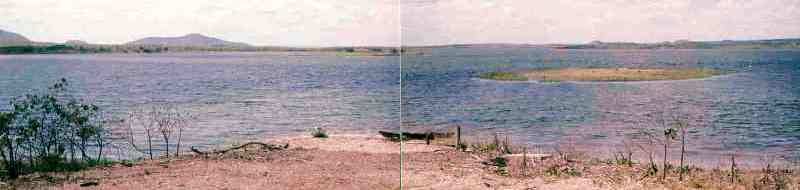
Site if Canudos, as it appeared after diversion of Vasa-Barris river.
Locals believed it was intentionally flooded by government
 
My next halt was at Recife and Olinda where I spent three weeks, mostly under the guidance of Gilberto Freyre's Joaquim Nabuco Foundation. With their help I found my valley of Santo Tomás and my imaginary town of Rosário, the locales for my fictitious family of Cavalcantis.
 
From Recife I traveled to Belém and embarked upon the Amazon, five days of brooding along the river sea to Manaus and on to Porto Velho. What I had in mind in journeying the wilderness was not so much Nature's glories but the men who were first to venture there: the bandeirantes. Nowhere but in those lonely tracts of forest could I get a sense of the enormity of their undertakings, their indefatigable spirit and courage.
 
From Porto Velho and Cuiabá, I headed south to Rio, São Paulo and Minas Gerais. After so many weeks it was a shock, traveling out of the backlands to the great cities. I was as bewildered and lonely as the sertanejo who goes south, but even as I felt this I knew my intuition to start my journey in the north had been right. Had I plunged into Rio or São Paulo at the start, I could've been drowned but up north I was able to absorb the Brazilian "thing" in small doses, day by day.
 
This is a very real problem in developing a book like mine, for in so short a time no outsider can possibly hope to get more than a superficial look at a great city like Rio de Janeiro. Which is why when I got down to writing Brazil I placed my two families beyond the cities, the Cavalcantis on Engenho Santo Tomás near Rosário and the da Silvas of bandeirante ancestry at the fictional Itatinga on the Rio Tietê, their worlds a microcosm of the greater Brazil beyond.
 
Glimpses of the Casa Grande, Pernambuco, Brazil
 

Brazil on Twitter - Telling the Brazilian National Epic in 25,000 Tweets

Brazil is the first country to have its story told on Twitter in a saga spanning 500 years in 140-character episodes!

I draw on my acclaimed historical novel, Brazil, for this staggering task. My "Twitter Edition" is tweeted live for 10,000 indefatigable followers of the epic which opens with the Tupiniquin Indians in May 1491 and continues to the 21st century.

Brazil on Twitter couldn't be more different from my original manuscript. A South African-born author now living in Boston, I spent five years on the writing of my book about Brazil, a land that captivated me since childhood. My research included a 15,000-mile journey in Brazil, almost exclusively by bus to get a feel for the country.

My travels took me into the sertão, the arid backlands of the Northeast and to the Casas Grandes of coastal Pernambuco. I voyaged the Amazon from Belém to Manaus and rode by bus down to southernmost Rondônia. I followed the route of the bandeirantes, the Brazilian pathfinders, west of São Paulo and roamed the highlands of Minas Gerais.

The writing of Brazil took five years. Like my fictional hero, Amador Flóres da Silva, I knew periods of utter loneliness and fear; times when I felt the caatinga closing in on me. Always, I broke through the barrier. I never lost the will to understand the Brazilian ˜thing."

When I sat down to write my original manuscript, I did so the old-fashioned way by hand. It was a staggering 2,454 pages penned on unlined scribbling blocks and later typed up on a 1930s Remington Royal with a draft of 756,200 words! A typewriter bought on a yard sale for $1. The first edition of Brazil was pared down to 1,000 pages and published by Simon and Schuster.


The newest edition, with an afterword that brings the story to the 21st century, is on Amazon Kindle and also in Print (personally signed copies available.)

What I love about Twitter is the ability to reach a new worldwide audience “ one tweet at a time!" I post 20 to 40 tweets a session, numbered, and in self-contained excerpts.

In its long form, Brazil, has won accolades from reviewers and readers across the globe:

"Uys has accomplished what no Brazilian author from José de Alencar to Jorge Amado was able to do. He is the first outsider with the total honesty and sympathy to write our national epic in all its decisive episodes.“ -- Professor Wilson Martins, Jornal do Brasil.

"A Masterpiece! Brazil has the look and feel of an enchanted virgin forest, a totally new and original world for the reader-explorer to discover." -- L'Express, Paris

"Pulsing with vigor, this is a vast novel to tell the story of a vast country. Uys recreates history through the eyes and actions of an awesome cast of characters seen at 'ground level." - Publishers Weekly.

"Uys has interwoven five centuries of Brazilian history and generations of two fictional families into a massive, richly detailed novel, Michenerian in sweep and scope, informative and intriguing.  Uys has a sense of pace and an eye for detail that rarely fail him. "-- Washington Post

In the wide world of Twitter, @BrazilANovel offers a totally new and original way to discover Brazil, a great nation and its people, one tweet at a time.

Tiny Puffs of Cloud That Fell to the End of the Earth

Brazil - The Making of a Novel - Part 5
 
Before leaving Portugal for Brazil, I prepared a list of objectives sent in advance to potential contacts in Brazil's cultural and educational ministries, historians and others whose names had been suggested by sources I'd met in Portugal:
 
Notes on Research Project: Brazil 
 
My novel is historical and a major part of my work can be
accomplished through a study of published sources.
 
No matter how assiduously this is undertaken, such bookwork
cannot offer on location observation with its inestimable
value in bringing comprehension and adding reality to your
perspective. The following notes, more or less in line
with my envisaged chapter structure, indicate the kind of
material and experience I am seeking.
 
Creative people are not supposed to be as formal as this,
but with so vast a project in mind  I have to adopt some
kind of organized strategy for the research stage
or I'll never put it all together.
 
1. Rain forest
 
I want to describe, in detail, a single acre —
"God's Little Acre," in a way — before mankind's
arrival. I need to speak with experts at a forest research
station (outside Belém?), who can explain, in simplest
terms, the symbiosis of the forest, its creation and
the miraculous web of life that ensures its survival.
 
I need a geologist to outline the creation of the Amazon
basin and the forces that shaped the sub-continent
as we know it today. A zoologist to tell me about
the animal life of the virgin forest. And a sociologist
who can expound on "man and the forest," the forest's
effect on man over the centuries, both indigenous
and immigrant. (Charles Wagley, An Introduction to Brazil,
has some pertinent remarks on this theme.)
[READ MORE]


Besides these research objectives, I offered a glimpse of my story lines, enough to grasp
my plans for the book and more specific research needs:
 
Notes on Research Project: Brazil
 
“While I am aware that the role of the rain forest
in Brazilian history should not be over-emphasized,
I want to open the book with a succinct evocation
of the lifecycle of an acre of virgin rain forest;
its creation and existence before the advent of mankind.
 
“The first dwellers in the forest, the Indians, are seen
in the period 1492-1500, eight years leading up to the
arrival of Cabral's fleet. Emphasis is placed on
the Tupi-Guarani branch and, in particular, a Tupinamba
and a Tupiniquin group. While a novelistic technique
carries the story forward, I am equally concerned
with a sympathetic account of their lifestyle and its
value-role in the formation of Brazilian society.
 
“After showing Cabral's landfall, my focus turns to
the Portuguese trading empire in the East, stressing
Goa and Ormuz, in the period 1506 — 1516 to give
the reader a concept of the men and women
who first settled Brazil and their heritage.
 
[READ MORE]
                        
 
These gleanings from my outline and in-depth reading and research were intended to convince those whose help I sought that I was involved in a serious project of which I already had more than a working grasp. A breathtaking and formidable task but which, after my two years with James Michener on The Covenant, I had every confidence of accomplishing.
 
I prepared a draft itinerary that would allow me to touch base with all the important locations in the novel, an itinerary clearly open to revision as priorities demanded.


Draft itinerary for visit to Brazil: July to October 1981

 
July 2                         Arrive Recife from Lisbon
July 3   - 7                  Recife/Olinda
July 8   - 12                Recife/Olinda area - "sugar plantation"
July 13  - 14               To Canudos - Pernambuco 'backlands' en route
July 15  - 16               Canudos
July 17  - 18               Salqueiro - Belém (surface)
July 19  - 21               Belém (Amazon forest research station etc.)
July 22                       Belém - Manaus (air)
July 23  - 26              Manaus
July 27  - 29              Manaus - Porto Velho (Madeira River?)
July 20  - Aug 8        Porto Velho - Madeira-Mamore railroad/
                                  Aripuana to Alta Floresta/ environs of Rio
                                  Roosevelt etc.
Aug 9                        Porto Velho - Brasilia (air)
Aug 10   - Aug 15      Brasília
Aug 16   - Aug 22      Brasília - Salvador via Sáo Francisco area
Aug 23   - Aug 29      Salvador
Aug 30                       To Porto Seguro
Aug 31   - Sept l         Porto Seguro - Ouro Preto
Sept 2   - 3                  Ouro Preto
Sept 4   - 10                Rio de Janeiro (lst visit)
Sept 11  - 15               São Paulo
Sept 16  - 24               São Paulo ( on coffee fazenda)
Sept 21                       São Paulo to Asuncion (air)
Sept 22  - 24              Asuncion, Paraguay
Sept 25  - Oct 3         Asuncion - Humaíta to Missiones area etc.
Oct 3    - Oct 17         Rio de Janeiro for consultations with local
                                  Historians/contacts
Oct 18                        Return to New York.
                                          
I was to begin my trip at Salvador, the Mother City, the best possible start to a journey in search of the “real Brazil,” as people in the south refer to Bahia. From Salvador I went to Porto Seguro and Cabrália, walking along the beaches and broad bluffs that are the setting for the opening of my book along the same beach where I saw the young Tupiniquin, Aruanã, at the water's edge on a day in 1500.
Porto Seguro,  Brazil
                
      Tiny puffs of cloud had fallen to the end of the earth. Four... five...six were bunched together just above the horizon, and others were coming to join them. Otherwise the sky was perfectly clear, its blue expanse streaked with the blazing color of the lowering sun.
 
     He made a hesitant progress toward the water, squinting into the distance at the strange clouds. But even as he did so and perplexed as he was, he began to see that his first impression had been wrong. Very quickly now the swiftest clouds lifted above the water and he saw a darker line. There was a flash of understanding: Here were great canoes coming from the end of the earth.
 
     Aruanã watched as they came closer. The sun was gone behind the trees, and he found it difficult to discern the craft, but he stood rooted a while longer before he realized that he must hasten to the village and tell what he had seen. This made him gaze at the horizon again, to be absolutely certain, for it was a fantastic discovery for a man who had gone to seek no more than shells for First Child. They were there, darkening images now, these canoes that had come from the end of the earth.

Landing place of Pedro Alváres Cabral, Brazil, 1500
 

A Novelist and the Shock of History

Brazil - The Making of a Novel - Part 4
 
My library forays in New York over three months provided the background for my initial plotting and book proposal. With the outline complete and broad themes of the novel well in mind, it was essential to have firsthand experience of Portugal and Brazil. I couldn't go back five hundred years, but I could make a sincere and honest attempt to know the land and its people.
 
I was writing a novel not a history but was committed to offering as authentic and historically accurate account as possible. In April 1981, I headed for Lisbon and three months later began my journey in Brazil.
 
I based myself outside Lisbon at Sintra, living in a quinta on a hillside below Moorish battlements that overlooked Sintra Palace. I would use this setting for the family seat of the first Cavalcantis to go to Brazil:
 
Sintra Palace

Through his marriage to Inez Gonçalves, Cavalcanti's father had come to possess lands on those serene vales before the Serra de Sintra. Here between jagged rocks of antiquity crowned with fallen battlement of Moor and the distant azure expanse of the Atlantic, here was past and future, and whether Nicolau climbed through the thick woods to the lee of the old Infidel redoubt or stood on the windy headland at Cabo da Roça, he felt an intimacy with both. - (from Brazil)
Errol Lincoln Uys at Serra de Sintra

 I divided my time between the Gulbenkian Foundation, British Institute and Portuguese historic and geographic libraries and visits to sites like Jeronimos Monastery, Belem Tower, Mafra, and traveling to Coimbra, Belmont and Evora, all of which have a place in my novel. Besides 16th century Portugal, I was also interested in the mid-18th century and events surrounding the Lisbon Earthquake of November 1755, one of my Cavalcantis studying law in Portugal at the time.
 
Ten seconds later, there was a devastating shock. The houses opposite Paulo began to sway; the floor beneath him vibrated so violently that he struggled to keep his balance. Chimneys crumbled, loose tiles fell to the ground, crockery in Dona Clara's house shattered. Screams and the pitiful cries of animals rose. But Paulo's perception of these noises was dulled by a thundering in the earth. Terremoto! The word crashed through Paulo's senses. “Earthquake!”
 
Paulo was mesmerized by the houses opposite, rocking on their foundations, walls cracking and splitting, upper stories leaning toward the street, chunks of masonry falling. Terror numbed him. He stood frozen at the window, expecting death.

Three houses suddenly burst open and collapsed, burying the family of four and the servant girls. The old man did not cease his struggle to open his front door, even as the convulsions rocked the street; he, too, was entombed by an avalanche of masonry. Paulo looked beyond the opening opposite him: The city was rising and falling in waves as if upon a storm-tossed sea; landslides swept down the hillsides hurling houses toward the lower ground; distant steeples and towers whipped about wildly; clouds of dirt and dust hung in the air. The thunder of the earth, the sound of breaking timbers, the rain of roof tiles — the inconceivable noises came together in one deafening roar of destruction. - (from Brazil)
Lisbon Earthquake 1755
 

Imagining Brazil

BRAZIL - The Making of a Novel - Part 3
 
As I let Brazil seep into my imagination, my first step was to compile a detailed chronology. Alongside this, I mapped out a genealogical timeline for my major families, initially the Cardosas and the da Silvas. I later changed the Cardosas to the "Cavalcantis."
 
As I worked on these timelines, I began to isolate the markers for my characters, the great events where I knew they would have to be present, the sidelines of history where there might be a role for them, as yet undefined and potentially as surprising to me.
 
The original Chronology extends from 8,000 B.C. with north-coast Andes sites of hunter-gatherers to 1981, the year I started my research. So, for example, from 1616 to 1681, the years covering the lifespan of my character, Amador Flôres da Silva, the bandeirante or pathfinder:


Once the Chronology was complete, I had enough material to flesh out my original plotting ideas in a detailed outline, proposing a saga spanning five centuries and involving multi-generations of two families, the Cavalcantis and the da Silvas whose stories depict the major historical elements in Brazilian society.
 
 
This ninety-page document comprised an Overview of the novel, Family Trees and the Outline itself.
 
My ideas would constantly evolve during a year of research and travel and throughout the actual writing. There would be many variations in the plot for I could not know where the characters I created would lead me but the broad plan held firm.